xbitlabs has a pretty good info on the new breed of processors from Intel. They have put it thru the test and come out good even with a sound beating and torture from the crew. Check it out...
Conclusion
Well, let’s sum up a few things now. Intel’s decision to equip their Core 2 Duo processors with faster 1333MHz bus support is regarded as another move towards higher performance of this processor family. It is partially true. As we have seen today, higher bus speed will obviously boost the performance in most applications. However, unfortunately, this boost will not be as significant as we hoped: it hardly ever gets beyond 3%. But, the changes in the bus frequency are not the only thing that determined the advantage of the new CPUs over their predecessors: different clock frequencies are another reason. For example, the nominal frequency of the top Core 2 Duo E6850 model has now risen to 3.0GHz, while before today the maximum frequency of the existing Core 2 Duo processors used to be only 2.93GHz. This also affects the performance, and together with the faster bus it brings in more confident victory of the top Core 2 Duo CPUs. In other words, the launch of the Core 2 Duo CPUs with 1333MHz bus will become another part of the progress CPUs on Core micro-architecture are making. Although we all wish that they were moving at a little bit faster pace towards the promising Penryn family.
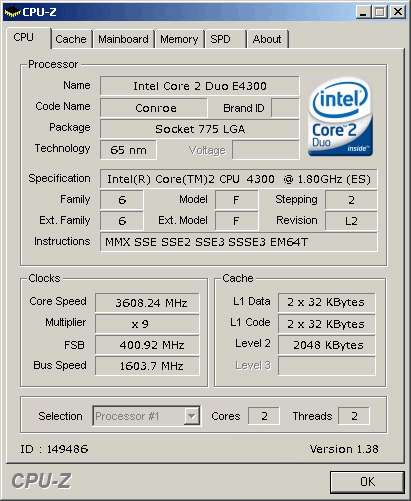
Higher bus frequency is not the only nice thing about the new processors. They are based on the new G0 stepping of the Conroe core that boasts better frequency potential. As a result, the FSB Wall has been pushed farther back and the overclocking results have improved significantly. For example, our overclocking experiments revealed that the new processors can work at 3.6-3.8GHz with traditional air-cooling onboard. Therefore, Core 2 Duo E6850, 6750 and 6550 should become very popular among overclockers, especially since Intel is going to price them very affordably. According to the preliminary data, Core 2 Duo E6850 will sell for $266, Core 2 Duo E6750 - for $183, and Core 2 Duo E6550 – for $163. This attractive price tag will certainly help Intel stimulate the transition to systems with 1333MHz bus.
Source:New Member In Core 2 Duo Processor Family: Introducing CPUs with 1333MHz Bus


 I snag some pictures over at INQ, and posted it here so you can also check out the nice images aside from those posted at the official
  DECEMBER 15, 2006 – Xtremelegends Philly-boy and FUGGER attained unprecedented success at the abit OC Xtreme workshop. It began as a slow day, working up to some speed. With various obstacles such as the LN2 being late we began with using a 3-stage compressor cooler. Initially we ran with a normal QE6700 Kentsfield “Core 2 Quad” processor pushing up the multiplier further and further. Clocking it up to 12x, then 14x. The results then improved drastically especially after the liquid nitrogen arrived, until late in the day some worthwhile figures came about.
 Several unusual benchmarks were also computed. The team was guided by a renowned expert in the shady sides of internet security. One thing of note was that with a special utility programmed onto our super overclocked monster, we were able to run a benchmark using the AES 128 bit encryption algorithm.(this is the standard used by many banks and secure websites around the world according to our specialist). It seems as if things are not as safe as we are led to believe. The brute force of our overclocked beast enabled roughly 10.5 million times cbc’s on 64 size blocks in 3.81 seconds. What that means to the layman is that in every four seconds, this computer could provide 10.5 million unique codes to attempt to crack a 128 bit encryption code sequence. In essence, if the decryption software is very good, then this OC beast computer could crack your (128 bit encryption) code in a matter of hours at the most... Before you spring into an uproar, please bear in mind that not everyone has liquid Nitrogen as a coolant, nor the assistance of the World’s best overclockers at hand. Then to make matters more complicated, you would need to have the VERY complex software to achieve this goal. But if you did, cracking codes would be a breeze.
  Special thanks must go out to Intel who co-sponsored the event: Intel has stood by abit strongly, helping us promote their flagship chipset and CPU, while giving abit the necessary collateral to make the event happen.