Showing posts with label core. Show all posts

Friday, January 20, 2012

Tech Link (Industry): Performance Tuning Protection Plan by Intel®

Intel released a very nice plan for CPU enthusiasts that is sure to be a hit for extreme overclockers. With plan selling for as low as $20, and $35 as the highest, enthusiasts that can buy $900 will be happy to have that extra protection.

The plan covers processors with "K" and "X" suffix and falls on Intel® 2nd Generation Core™ processors based on LGA2011 platform. Note that while Intel offers this plan, Intel is still playing it safe and not "endorsing" overclocking.

For the typical overclockers, this option is, just that, an option. What this plan really applies to is when enthusiasts starts pushing volts way beyond specification using exotic coolers. Of course, even casual overclockers using stock aircooler can avail of this, if only to get that secure feeling and guilt-free conscience if and when you break your CPU.

Here's the breakdown:
  •  Intel® Core™ i5 2500K= $20
  •  Intel® Core™ i7 2600K= $25
  •  Intel® Core™ i7 2700K= $25
  •  Intel® Core™ i7 3930K= $35
  •  Intel® Core™ i7 3960X= $35

Tuesday, March 16, 2010

Brag: Oooo, 4GHz easy on my Intel® Core™ i7- 980X Extreme Edition

Yeah baby!!! I got 4GHz...well, not the best out there but hey, if you're as busy as me with my kids and what nots, you won't have enough time to tinker with these bad boys. I always want to play around and find the sweet spot of the QPI and the Multiplier combo but I guess gone are those days for me.

I mean, wow, so many hexa cores and a dozen of threads, I can only guess about the price. Yes, I think this would be "pricey" compared to what's out there right now, but considering how Intel price their EE (extreme edition process) and if it remains the same, then the price is very much "reasonable".

Case in point, the Intel® Core™ i7-975 Processor Extreme Edition and Intel® Core™ i7-965 Processor Extreme Edition both runs at estimated $999 bucks. And I'm pretty sure the older Intel® Core™2 Extreme Processor used to cost as much.

Good luck and have fun, FanBoy out!

Friday, February 19, 2010

Brag: Intel® Xeon® Processor W3520 overclocked to 4GHz

I am just too itchy to get myself rolling back to the picture again. You know, my Blog, I'm trying to make it active. And what's the best way to get your Blog active? Well, post your hobbies and things that you like.

And this time around, I pushed an Intel® Xeon® Processor to a blazing fast 4GHz processor! I love how this processor overclock so easily, considering my board isn't the best overclocking board out there. Well, I almost gave up when I can't even bring Host Frequency a wee bit pass 160Mhz but nevertheless, I found what's holding me back and zoom, 4GHz is achieved!

I'll probably try and post a benchmark as well as my OC experience, but don't hold your breath for that. The keyword here is "try" =). Fanboy out!

Misc: Breaking 4GHz with Intel® Core™ i7-920 Processor

I played around with this process for some time and overclocked it a bit. I had a lot of fun and interesting experience pushing this processor to 4GHz. I would have posted a review, but there are a lot of reviews about this processor already so I never made one. Besides, almost every enthusiasts, except those AMDroids, will be very familiar of how this processor performs.

If I got some time, I'll post some benchmark results and some settings I used to achieve this overclock. I did encounter a few hiccups along the way, but nothing mind boggling or out of the ordinary.

So how's your 920's overclock experience? If you have anything to share or ask, just hit the comments section!

Tuesday, February 16, 2010

Brag: Intel Gulftown CPU-Z is up and validated

As I used to say back in the "old days", the Dark Force is strong, alive, and kicking. Oh dear, I need to find where I stashed all my decent RAM. Oh yeah, the motherboard is a workstation board.

I'll tinker around and see if there's some tweaking options for this board. If there is, I'll probably overclock it a little. Hmmm, I need to "steal" someone else's video card too, probably a decent GTS 250. But sorry, I can't show any benchmark whatsoever. And oh, you can click on the image of CPU-Z to get to the validation thingie.

If you want to see Task Manager, temperature, voltage, and other CPU details, click this link (not a virus, I assure you)!

And oh, if you're saying how come its frequency is so low, well I uploaded another CPU-Z validation here!

Sorry for this incoherent mubling disguised as a post trying to pass it like a readable blog entry, till next, FanBoy out!

Wednesday, January 07, 2009

Misc: A great New Year 2009 To All

Well, I guess I'd like to say and greet everyone a Happy New Year. If anyone else is wondering, yes I am still very much into IT and CPU and Chipset and the likes. As a matter of fact, if you look at the CPU-Z in the right image, you'll see my Nehalem CPU-Z submitted way before it was launched last year! But umm, I know I never posted it here because my Blog has ceased right?

Anyway, again I'd like to greet you all a great New Year. If anyone is thinking whether I'd moved away from this field, nope and I see myself staying in this field for quite a few more months, if not years, to come.

The technology is really exciting, and I'm actually interested to see how CUDA will grow and show its fangs against IA x86 architecture. It'll be an interesting battle to see in the near future.

So, till next and I wish you all again a great New Year!

Tuesday, July 17, 2007

Tech Link (Roadmap): Intel Pulls Yorkfield Extreme Edition Into 2007

Looks like better days are coming for the true and faithful FanBoys. The newer products are going to launch earlier than originally sceheduled. It bodes well for those planning an upgrade, or just want to get their hands wet with the latest and greatest. Ready your wallet boys and girls (image from VR-Zone).


Intel has brought forward the launch of Yorkfield Extreme Edition from Q1 2008 to Q4 2007 bringing pressure to AMD Phenom FX slated for launch later this year. Intel has not determined the final clock speed of Yorkfield Extreme Edition but it will be at least 3.33GHz/1333FSB with 2 x 6MB shared L2 cache. Yorkfield and Wolfdale schedule remains unchanged at Q1 2008 and there are 2 SKUs for Yorkfield and 4 SKUs for Wolfdale.


Source:Intel Pulls Yorkfield Extreme Edition Into 2007

Wednesday, February 14, 2007

Brag: Intel® Core™ 2 Duo E6320 says "aye"

After the failed attempt to determine if my new CPU is already Penryn one, I decided to try the next CPU in the queue. You can click on the image to zoom up on the CPU-Z image.

Well, this one is still not my highly anticipated new CPU based on the new core. Oh well, I guess I still have the other CPU to try out. For now, I am removing the details of the CPU and just posting very limited information since I don't know how much info is being posted already on the next.

In any case, I plan to test the third, and last flavor of CPU I got next week. So you may want to check back again to see if I do end up with a Penryn core next time. For now, I will leave you all with the guessing. First, you've seen the overclocked Conroe-L, now, this E6320. Time to hunt for the details using your trusty Google.

Have a good Valentines Day

Friday, January 12, 2007

Brag: Intel® Core™ 2 Duo E4400 is here, and they overclock well too!

I have posted the first CPU-Z validation and overclock of Intel® Core™ 2 Duo E4300 on the web, now I am posting the first Intel® Core™ 2 Duo E4400 CPU-Z validation. This is a great processor for high clockage. You can click on the image to view the CPU-Z validation, and my specs i.e. what RAM, and motherboard is used. Aside from the multi of 10x, it's similar in every aspect with the younger brother Intel® Core™ 2 Duo E4300.

I quickly put this to a crash overclock test, and whipped out the first board I laid my eyes on. It is the Bad Axe 2, and I believe, is a great choice. After a brief testing, I manage to get it stable at 3.5GHz which is a hefty 75% overclock.

Hmmm, another great processor from Chipzilla! For high FSB, just lower the multi like its younger brother, but for high clockage, just stick to the default multi and pump up that FSB. Woot!

Tuesday, January 09, 2007

Tech Link (Processor): Cheaper Core Micro-Architecture: Core 2 Duo E4300 CPU Review

XBitLabs has finally gotten their hands with the coveted E4300 series of processor which I overclocked at more than 100% (which was 95% overclocked before) and posted early last year even before the world have seen any CPU-Z validation. Check out the review and get ready for the wave of the uber overclockable processor from Chipzilla. Expand for more..


Conclusion
The Core 2 Duo E4300 processor has left a positive impression on us. It can become a bestseller thanks to its rather low price - after all, it is the cheapest CPU in the highly appealing Core 2 Duo series.

Performance of the Core 2 Duo E4300 isn't that impressive as that of the senior models of the series. Although it differs by only 3-5% from the Core 2 Duo E6300, the new CPU is slower than the Pentium D 945 and Athlon 64 X2 4200+, which cost about the same money, in some benchmarks. But there are few such benchmarks and the new CPU is far more economical than any of its opponents.

The Core 2 Duo E4300 is also a gift for overclockers since it doesn't require special overclocker-friendly components and has an affordable price. But to all appearances, Allendale-based CPUs won't reach as high frequencies at overclocking as Conroe-based CPUs do.


Source:Cheaper Core Micro-Architecture: Core 2 Duo E4300 CPU Review

Tuesday, December 26, 2006

Brag: One Hundred Percent Plus Overclock (100% +++) with Intel® Core™ 2 Duo E4300 (Anniversary Special Post)

This day marks my First Year anniversary. While there's no cakes, balloons, or fireworks to celebrate it, I decided to remember this day and make it memorable by hitting a certain goal: 100% overclock of Chipzilla CPU. I have always been busy, always putting this Blog site to neglect, that I even forget posting some items. So to make up for it, I'll be spending time, and this time, I'll be spending my time playing with toyz and doing what I love most: tweaking hardware. And the victim is, the unreleased, Intel® Core™ 2 Duo E4300.


And so, I finally got some quality time for the yet-to-be-released processor(Intel® Core™ 2 Duo E4300) and got intimate with it. I have been easy-goin' with this baby till today but since this is my First Year Anniversary, I decided to put the CPU for some OCing goodness and I won't be soft this time.

After ensuring I have the latest beta BIOS (thanx NicoOCZ) on my Abit AW9D-MAX board working flawlessly (some reported a borked board after the flash), I put this board for some warm up. I put my Intel® Core™ 2 Duo E6400 and started pushing it till 400FSB and the system is very stable. I recorded all the settings, for both the RAM and motherboard, and ran stability testing software. I used the new multithreading Prime95 software (thanx eva2000) since I don't really like Orthos. So at a mere stock voltage on CPU, lowly 1.6v in vMCH, and 2.3v on RAM, it's perfectly stable and I can even complete any bencmark software I throw at it.

The result is very promising, and looking good in preparation for the Intel® Core™ 2 Duo E4300 overclocking spree. The last time I overclock it, I hit 95% overclock. But aside from lacking inspiration and the will to overclock, I gave up after not making it able to boot up past 395MHz.

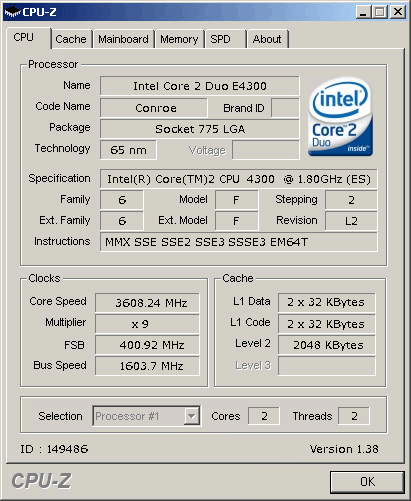
But today is a different day than during the first time I overclock this bad boy. First, I have all the time in the world, without worrying if I have completed all my obligations before doing what I love most: playing with hardware. Second, I am such a fan of this kind of powerful yet low cost processor and I'd like to see how far it'll go. Third, it's Christmas season and I'd like to give myself a self-gratification of reaching 100% overclock on stock cooler, on an unmodded board! And last but not the least, it's my freakin' First Year Anniversary post. Anyway, if you clicked on the image, you'll see that I hit 100% OC on FSB already but this isn't truly 100% since I lowered the multi from the default of 9x to 8x, giving a hefty 3.2GHz clock frequency. However, the vMCH must be set to 1.7v!

So I tweaked the board, while still making sure that I am within my sanity's limit. At 1.7v on the vMCH, and 2.3v on RAM, I changed the multi to it's default of x9. Unfortunately, the system with reboot upon reaching Windows screen. It won't stabilize. This time, I am already pumping 1.5v from 1.425v that I used to ran at 3.2GHz. It will still not boot up, so I figure, either I change the cooler or pump the vCore even more. However, I am a lazy bum and I don't like to replace the stock cooler since it's much easier to pump the vCore than replace the cooler. Besides, I am not in the mood to change the cooler, and re-apply all the thermal goo and all that.

So, I just pumped 1.6v and be done with it, and woooolah, I hit the magical number. I don't know how stable it is, I could care less. I am not after stability, just clockage. If I wanted stability, I would have used a better RAM that runs at stock of DDR2-800 and aftermarket cooler. I reached 100% overclock, and I figure, why not go further? Not being satistifed with 100%, I decided just to push it a litte more, just something for Christmas and Anniversary spirit.

So mustering all my strength and the will to carry on, I brought up the FSB to 402MHz, but it's a no go. But 401MHz is just fine, so I inch a little to 403, and it's good to go. Hmmm, interesting, I went up further and shoved 404MHz and it works. At this time, I am just getting tired and lazy of all the reboots and save, so I pushed to 410MHz, and it's no go. After a few more misses, I settled for 406MHz final FSB on stock cooler, on air. Here's the final overclock of 103%! You may click on the image for the CPU-Z validation.


That is all FanBoyz, and have a Happy Holidays!

Sunday, December 24, 2006

Tech Link (Motherboard): MSI P965 Platinum

The folks over at [H] has placed an MSI i965-based board to the test bench. While it performs well and shows no sign of nagging problems, [H] doesn't give this board a big thumbs up. Check it out...


Dan's Thoughts:
Working with the MSI P965 Platinum was a pleasant experience, but not a perfect one. For starters, the motherboard always changes the boot sequence whenever any drives are added, or if the drive configuration changes in anyway. This lead to a situation where the system wouldn’t boot, and I’d have to go back into the BIOS and change the boot sequence again. This is not an issue that is specific to MSI as many motherboards do this, but there has been a change started in the industry to correct this. Otherwise, I also had several issues with stability until I raised the ram voltage to 2.1v. The memory defaults to 1.8v, which was totally unstable. (Editor's Note: In my testing with different Corsair RAM we showed not voltage issues whatsoever.) I had another issue once the OS was loaded originally. When I went to install the .NET framework, and the Catalyst 6.9 drivers for my test X1800XT Crossfire setup, the OS blue screened, and I was forced to re-install it. This was an isolated incident, and I have no explanation why this happened.

Stability at stock speeds, while running my drive benchmarks and network tests was exemplary. For 48 hours, the system ran flawlessly, and gave me no issues. During the stress test I ran Orthos and ran SuperPi along side it just to be extra abusive. The system performed flawlessly under these conditions. Overall the MSI board was easy to work with and the problems I did encounter were easy to solve or work around entirely.

Essentially, the P965 is a great motherboard, especially at stock speeds, but unremarkable. Overclocking is mediocre, but not horrible. The layout is excellent, and the board has a solid feature set, and isn’t over burdened with an excessive amount of features that most users will likely never touch. Some issues I experienced were annoying, but should easily be fixed with BIOS and driver updates. All in all the P965 Platinum merits some consideration and I would recommend it for use in non-overclocked or mildly overclocked systems, but for the hardware enthusiast, I think there are better choices out there.

The Bottom Line
MSI has presented us with a very stable motherboard in the P965 Platinum. It ran like a champ under very heavy usage models at stock settings. When it comes to enthusiasts looking for overclocking motherboards for new Core 2 Duo processors, there are better choices available.


Source:MSI P965 Platinum

Friday, December 22, 2006

Tech Link (Platform): Octa-Core Computing : Intel’s Cloverton Xeon Processor

This is a bit late, but I since I missed posting it, I figure better late than never. So, GamePC has put up an article for which I can't do because, well, I'll get my ass kicked for breaking NDA. Anyway, they have a comprehensive review, but I only have one peeve: they mentioned they have a Maxon Cinebench 9.5 benchmark but they actually don't have it in there :(. Bummer....


The Final Word

Intel’s new quad-core Xeon 5300 series processors can offer spectacular performance at fairly low clock speeds, while at the same time consuming no more power or creating no more heat compared to higher-clocked dual-core variants. On a technical level, we feel that the chip is certainly a success, as one can now deploy eight-core systems just as easily as dual and quad-core systems of yesteryear. With new standard ATX sized Xeon motherboards from Tyan and Supermicro, it’s also now possible to have eight-core computing in a standard ATX sized case, something which would simply be impossible as of last year. Eight-core systems used to require proprietary (read : ultra expensive) components and were extremely limited, whereas with these new Xeon 5300’s, one can assemble an eight-core system using over the counter components.

As one would expect, Intel’s quad-core Xeon processors are quite expensive - roughly double the price of their dual-core brethren at the same clock speeds. Price wise, an eight-core setup with 2 x 1.86 GHz quad-core processors will cost about the same as a quad-core setup with 2 x 3.0 GHz dual-core processors. So, which is better, more cores or higher-clocked cores? Turns out that in the majority of our benchmarks, a highly-clocked quad-core setup will outperform a lower-clocked eight-core system in most real-world applications. This is simply due to the fact that most applications don’t know how to handle eight cores, whereas most multi-threaded applications can properly handle four cores without getting too confused. If you have an application which is heavily multi-threaded and can take advantage of eight cores, the Xeon 5300’s actually provide better price/performance compared to the dual-core 5100 series. However, such applications are extremely rare on the market.

For everyone outside of the high-end server market, or those who heavily multi-task with multi-threaded applications, this chip will simply be overkill. However, an interesting area to consider will be virtualization, which will very likely show these eight-core processors in a much more positive light. A fairly inexpensive eight-core system could potentially run dozens of servers at with low power consumption and low-heat, which is certainly attractive for potential rackmount customers. For workstation and desktop users though, we would recommend sticking with the dual-core Xeon 5100 series until quad-core prices drop and software can catch up with what this hardware is capable of.

While it’s a great product to drool over, the real-world benefits of an eight core system are few and far between for the vast amount of users out there. Even during heavy multi-tasking, we couldn’t feel a difference between and eight-core and a four-core system. We applaud Intel for getting the prices of eight-core systems down to a far lower-level than they once we, and once again raising the stakes against AMD (who won’t have eight-core systems available until mid-2007). We’ll update our scores once Intel starts shipping the high-grade (2.33/2.66 GHz) quad-core Xeons in the coming month.


Source:Octa-Core Computing : Intel’s Cloverton Xeon Processor

Sunday, December 03, 2006

Tech Link: TYAN® T-650QX Personal Super Computer

I am not sure if I have posted it before, (I searched and can't find it) so I am {re)posting it (again). It's about a really cool PC that can support 40cores, that's so many. Warning before you proceed reading the full specs, be sure to have a tissue ready to wipe out your drool. Here's the short listed features:


  • Up to 256 GFLOPs computing power at your desk!

  • Turnkey, Easy-to-Deploy, and Easy-to-Use

  • Integrated 5 node cluster - up to 40 processor cores in a box!

  • Plugs into standard wall outlet

  • Supports Microsoft Windows Compute Cluster Server 2003 pre-installed and most popular Linux Operating Systems.

  • High Performance in Constrained spaces: Office, Remote, Plane, Boat, etc
    RAID capable

  • Hands On Supercomputing Experience


Typhoon Target Usage
High Performance Computing
TyanPSC's Typhoon™ 600 series Personal Supercomputers are purpose-built for individual and workgroups. With the Typhoon™ PSC, users have the power of a supercomputer right in their office or laboratory environment, so they can achieve more efficiency, with faster results.

Supercomputing for Energy Exploration
Reservoir simulation can now be done by individuals scientists in the field. The Typhoon's ease of deployment makes it easy. This can be vastly more efficient and profitable for the organization by providing preliminary analyses to sharpen and focus exploration efforts.

Supercomputing for Manufacturing and Engineering
TyanPSC's Typhoon™ Personal Supercomputers are ideal for replacing older, dated workstations.
The Typhoon™ meets the needs of engineers in the automotive and aerospace fields by providing a new level of simulation capability in the office.


Source:T-650QX

Thursday, November 30, 2006

Article: Intel® Core™ 2 Duo T7200 Preview (Intel® Core™ for Mobile)

Wow, what do you know, I failed to post this again like the Bad Axe one. Sounds like I am too busy last month that I tend to forget I am doing things. In any case, I decided to do some tweaking with the Conroe's little brother, Merom and see how it goes in the desktop. Check it out...


The Intel® Core™ 2 Duo T7000 series of processors is the successor processor to the Apple* baby which is the first "Core" processor, the Intel® Core™ Duo T2000 series. This processor is the younger brother of Conroe (desktop) and Woodcrest (server). It shares all the features of the desktop and server brothers, only that, this processor is targetted for mobile computing.


Source:Article: Intel® Core™ 2 Duo T7200 Preview (Intel® Core™ for Mobile)

Friday, November 24, 2006

Tech Link (Processor): Intel to strengthen Core 2 Duo lineup in 2Q/3Q 2007

Is it a good news or is it a better news? Either way, it sounds better :). Digitimes reported that on top of the upcoming E4xxx series, a new E6x50 will also crop up. This will give consumers more choices (though the site claims it's going to replace the current line up). Again, whether it's the replacement processor or another flavor to spice up your life, just prepare your wallet and make it fat enough to savor the latest offerings.


Intel to strengthen Core 2 Duo lineup in 2Q/3Q 2007
Yen-ting Chen, Taipei; Steve Shen, DigiTimes.com [Thursday 23 November 2006]


In addition to the Core 2 Duo E4300 CPU, which Intel is slated to launch in the first quarter of 2007, the chip giant will add two Core 2 Duo E4000-series CPUs, the E4200 and E4400, in the second quarter of next year, according to sources at Taiwan-based PC makers, who viewed Intel's latest roadmap.

Intel originally planned to launch the 1.6GHz E4200 in the fourth quarter of this year to compete with AMD's Socket-AM2 Athlon 64 x2 3600+, but later on, the launch was suspended to make way for the 1.8GHz E4300 CPU, the sources indicated, without elaborating on what prompted Intel to delay the appearance of the E4200.

In the third quarter of 2007, Intel also plans to launch the Core 2 Duo E6390 CPU for the mid-range desktop segment, as well as the Core 2 Duo E6850, E6750 and E6650 CPUs for the high-end segment, according to Intel's latest roadmap, the sources said.

Featuring a 1333 MHz FSB, the E6850, E6750 and E6650 will get the roles being currently played by the Core 2 Duo E6700 and E6600 processors, which both have a 1066 MHz FSB, according to the sources.


Source:Intel to strengthen Core 2 Duo lineup in 2Q/3Q 2007

Saturday, November 18, 2006

Brag: Intel® Core™ 2 Duo E4300 95% overclock on stock cooler

I manage to overclock the poor little CPU to a high 95%. I don't know if this is a world record Conroe/Allendale overclock on air with stock cooler, but I think it is.

You can click on the chipzilla logo or click here for the CPU-Z validation.

Some of the tidbits:
Motherboard: Abit* AW9D-MAX
Memory: Micron Fat Body D9 DDR2-533MHz 2x512MB
Hard Drive: IDE 80GB Seagate
Optical Drive: IDE Generic DVD ROM

That is all for the day FanBoyz...

Wednesday, November 15, 2006

Press Release: Intel Ignites Quad-Core Era

Ok, today is the day that marks the new era of computing power for the world. Chipzilla first introduced dual core on the desktop, and now, they are again the first to issue the power of four cores computing to the desktop. Expand to check out the full press release.


Intel Ignites Quad-Core Era
World’s Best Microprocessor Gets Even Better
SANTA CLARA, Calif., Nov. 14, 2006 – Intel Corporation today kicked off the computer industry’s multi-core PC era by delivering four computing “brains” inside a single microprocessor with the introduction of the Quad-Core Intel® Xeon® 5300 and Intel Core™2 Extreme quad-core processor families. These products deliver immense speed and responsiveness for general purpose servers and workstations and for digital media creation, high-end gaming and other market segments that crave absolute performance.

Intel began the transition to multi-core technology 4 years ago with Hyper-Threading Technology (HT Technology), followed by the introduction of the industry’s first dual-core PC processors in April last year. Intel recently refreshed its entire product line by introducing over 40 new processors, including those based on the revolutionary Intel® Core™ microarchitecture, a more powerful yet energy-efficient design.

“Today’s announcement ushers in another new era in computing,” said Paul Otellini, Intel’s president and CEO. “The capabilities of quad-core microprocessors will bring new possibilities for science, entertainment and business. I’m incredibly proud of what Intel’s employees have achieved with these new products.”

Intel has made this next step in the computer’s ongoing evolution as fast and easy as possible through continued investment in silicon process and manufacturing technology, innovative and tailored product design, and a myriad of software developer tools and programs.

Quad-Core Intel Xeon processor 5300 series

Extending the leadership established by the Dual-Core Intel Xeon 5100 series processors, the new Quad-Core Intel Xeon processor 5300 series sets new world records** on key industry standard benchmarks:


A Dell PowerEdge 2950 server running BEA JRockit JVM delivered a record breaking SPECjbb2005 result of 210,065** BOPS, as much as 61 percent better than the next result.
Using the SPECint_rate_base2000 benchmark, which measures integer throughput, Fujitsu-Siemens PRIMERGY TX300 S3 set a new world record with a score of 200**, up to 63 percent better than the previous record.
A HP ProLiant ML370 G5 server running TPC-C benchmark, which measures database performance, shattered the previous record by as much as 42 percent with a score of 240,737** tpmC at $1.85/tpmC.
An IBM System x3650 server running the LS-DYNA 3-vehicle-collision workload, a leading high-performance computing benchmark, set a new record for a single-node performance**.

In addition, OEMs have published record-breaking** results on SAP-SD 2-Tier**, SPECWeb 2005**, SPECfp _rate_base2000**, Fluent** and SPECapc 3dsmax Rendering** benchmarks. The chips deliver up to 2.5 times the performance of the fastest competing processor** for the ultimate in powerful, dense and energy-efficient general purpose servers.

Quad-core Intel Xeon Processor 5300 series servers provide more headroom for server virtualization than any other two-processor, standard, high-volume server platform. The new processors deliver up to 50 percent faster** performance within the same thermal envelope and at the same cost as the previous generation Dual-Core Intel Xeon processor 5100 series launched less than 5 months ago.

Four Intel Xeon processors are launching today at clock speeds ranging from 1.60GHz to 2.66GHz, with front side bus (FSB) speeds ranging from 1066MHz to 1333MHz, and thermal design power (TDP) of either 80 watts or a performance-optimized 120 watt option. In the first quarter next year, Intel will launch two more quad-core Xeon processors – a low-voltage version for ultra-dense deployments with a TDP of only 50 watts and a processor designed for single-socket workstations and servers.

Intel Core 2 Extreme quad-core processor QX6700

The world’s best desktop processor for multimedia applications, the Intel Core 2 Extreme quad-core processor QX6700 is up to 80 percent faster** than the company’s current Intel Core 2 Extreme Processor X6800.

This is the world’s first quad-core desktop processor available for unmatched, highly threaded performance. Ideal for today's games with incredible performance for tomorrow’s highly threaded games; the Intel Core 2 Extreme quad-core processor QX6700 is available at 2.66GHz with a 1066MHz FSB. The processor runs on Intel’s existing 975X Express chipset family.

The company plans to offer a mainstream quad-core processor starting in the first quarter next year under the Intel Core 2 Quad processor brand name. The processor will be an ideal choice for processor-intensive, highly threaded programs such as entertainment, gaming and multimedia activities.

Pricing and Availability

Quad-Core Intel Xeon processor X5355 2.66GHz 1333MHz 8MB 120W
$1172

Quad-Core Intel Xeon processor E5345 2.33GHz 1333MHz 8MB 80W
$851

Quad-Core Intel Xeon processor E5320 1.86GHz 1066MHz 8MB 80W
$690

Quad-Core Intel Xeon processor E5310 1.60GHz 1066MHz 8MB 80W
$455

Intel Core 2 Extreme quad-core processor QX6700 2.66GHz 1066MHz 8MB 130W
$999


Additional information and resources in the Quad-Core Media Kit

Intel, the world leader in silicon innovation, develops technologies, products and initiatives to continually advance how people work and live. Additional information about Intel is available at www.intel.com/pressroom.


Intel, Intel Core, Xeon and the Intel logo are trademarks or registered trademarks of Intel Corporation or its subsidiaries in the United States and other countries.


Source:Intel Ignites Quad-Core Era

Saturday, November 11, 2006

Brag: Intel® Core™ 2 Duo E4300 is here

I just opened up the new box of goodies I got and it has a pleasant new suprise. It is the the new processor with 800MHz FSB, yep, not the full blown 1066 but hey, this should be one good CPU to have that sure is ready to rock and roll with fast DDR2. You can click on the image for the validation link. Expand for more...

Now why did I say rock and roll? Well, if you're one of those overclocker who happen to have the newer mobos but still using the older generation CPU then this is one good upgrade path. The motherboard will surely have enough juice for at least 266MHz FSB while a DDR2-533MHz can easily do that on stock vDIMM as well. So yeah, this looks like a very good upgrade path. See details below...

CPU : Intel Core 2 Duo E4300 (*1)
CPU Arch : 2 Cores - 2 Threads
CPU PSN : Intel(R) Core(TM)2 CPU 4300 @ 1.80GHz (ES)
CPU EXT : MMX SSE SSE2 SSE3 SSSE3 EM64T
CPU Cache : L1 : 2 x 32/2 x 32 KB - L2 : 2048 KB
Core : Allendale (65 nm) / Revision : ???
CPUID : 6.F.2 / Extended : 6.F
Freq : 1800.09 MHz (200.01 * 9)

Monday, October 30, 2006

Tech Link (Platform): Intel Xeon and AMD Opteron Battle Head to Head

Whether the topic is on the desktop computing, laptop computing or server computing, rest assure that Intel's great processor and chipset uA is the best. In this review, THG puts Woodcrest head to head with the competition and comes out the big winner. Expand to check out the conclusion...


The Woodcrest platform performed very well, exceeding our initial expectations. It is the fastest in all of the tests and completely dominates our benchmarks. The new Xeon 5100 series helps Intel to get back on track, providing class-leading server/workstation processors. The now older 5000-series (Dempsey) Xeon, based on the Netburst architecture, is often last in the competition and merely serves as a point of reference in our tests.

Intel has retaken the throne from AMD in the server/workstation sector and sent AMD back to the drawing board. Next month Intel will release the quad core Clovertown CPU with 2 combined Woodcrest cores. AMD is ready for this threat with the introduction of their X4 Opteron, which is reported to have a L3 cache. Servers will benefit more from these quad core processors than desktop users due to the limited deployment of multithreaded-capable applications in the desktop sector in comparison to the server sector.

In mid-2007 AMD is expected to answer Intel's new threat with a line of faster Opterons utilizing the new Socket F, as well as support for DDR2 memory. Whether or not this will be enough to regain the performance lead has yet to be seen, but with no major architectural changes, it is expected that Intel will still retain the overall better performance per watt status.

In all, both platforms perform quite well, but the nod goes to the Xeon 5100 series for its superior performance and greater efficiency.


Source:Intel Xeon and AMD Opteron Battle Head to Head