Showing posts with label chipset. Show all posts

Thursday, August 28, 2008

Tech Link (Industry): Hell Freezes Over: NVIDIA Announces Native SLI Support for the Intel X58 Chipset

I know, my Blog has long gone to "rest", but this news made me post again, talk about being a Fanboy *yikes*. Anyway on with the news, if there's anything Intel has been missing on for quite some time in the Chipset-GPU support arena, it is the lack of native support of SLI on Intel-branded-chipset. Since the first release of PCIe way back the i915 series (Grantsdale), it has always been clamored and requested by Intel users: fanboys or normal users alike.

There has been earlier attempts on i915P thru some "rare" products such as the Albatron Mars PX915SLI, but for some weird reason, after some time, SLI support has gone "poof". Also for those hardcore Intel fanboys, they will recall that first ever SLI was indeed supported on Intel E7525 (Tumwater???) platform even before the word SLI became a household name among the techies. Later on, a few "hacked" drivers were released to support the later series of chipsets but soon, these hacked drivers became unpopular specially when "FM Approved" drivers became the norm, diminishing the results obtained from hacked drivers.

But alas, all is not lost, Skulltrail platform has been introduced. However, like the earlier SLI support, the D5400XS is based on a pricey server chipset with dual CPU slot and so adoption isn't as "common".

Hmm, I guess it's a bit of a mouthful introduction. Anyway, there are a few articles now floating on the web and I happen to grab this one from AMDTech (oops, Anandtech I mean):

Of course NVIDIA would wait until I physically left NVISION 08 to actually make an interesting announcement, but there’s no bitterness, I swear :)

The big, no, huge news from today? NVIDIA is enabling native support for 2 and 3-way SLI on Intel X58 based motherboards...without the use of any nForce 200 chips


Source:Anandtech

Wednesday, June 06, 2007

Tech Link (Motherboard): Intel X38 Express Chipset Surfaces

DailyTech posted a scoop on the i975x chipset replacement, in the form of X38. It seems many manufacturers are jumping in to this bandwagon and are really beefing up their line up of motherboards based on this chipset. I am excited to see how it will perform, on stock and in overclocking. Expand to read the news post...


ntel's 975X Expess gets the "Bearlake" upgrade

Intel will unveil the high-end version of its Bearlake-family next month – the Intel X38 Express. The new Intel X38 Express replaces the 975X Express, which launched over a year ago with Intel’s Presler Netburst processors. The new chipset introduces new features to Intel’s high-end enthusiast and workstation platform such as PCIE 2.0 and DDR3 memory.

New to the Intel X38 Express is support for dual full-speed PCIe 2.0 x16 slots. The dual PCIe 2.0 slots are compatible with AMD’s CrossFire technology for multi-GPU graphics processing. Motherboard manufacturers are also free to equip Intel X38 Express based boards with a third physical PCIe 2.0 x16 for triple-play physics. Due to chipset limitations, the third physical PCIe 2.0 x16 slot has lesser lanes, with most manufacturers opting for four lanes.

DDR3 is the only officially supported memory for the Intel X38 Express. Intel touts DDR3-1333 memory for X38 Express motherboards. DDR2 memory support has been removed officially from the X38 Express, however, the memory controller can still function with DDR2, just without Intel validation. The DFI LANParty X38-T2R will pair DDR2 support with the Intel X38 Express chipset.

The Intel X38 Express also supports upcoming Intel Penryn-family dual and quad-core processors with front-side buses up to 1333 MHz. The new Penryn family is Intel’s first 45nm processor family, expected to launch in Q1’2008 for consumer desktops. Desktop Penryn-family Core models will launch in early 2008.

ASUS, Biostar, DFI, Gigabyte, Intel and MSI have X38 Express-based motherboards on display at Computex 2007. ASUS plans to release an X38 Express-based workstation board. The upcoming ASUS P5E3 WS Professional pairs the X38 Express with the ICH9R south bridge. The board supports dual-channel DDR3-1333 memory, with no mention of ECC support. The P5E3 WS Professional does not have a third physical PCIe 2.0 x16 slot. ASUS opted for a vanilla orange PCB with the P5E3 WS Professional.

Biostar is preparing the TX38D3-A7 Deluxe with three PCIe 2.0 x16 slots. Two of the PCIe 2.0 x16 slots operates at full speed while the third slot has four lanes. Biostar also adds one PCIe x1 and two PCI slots into the mix. The TX38D3-A7 also features onboard power and reset buttons for the tweaking-inclined.

DFI has two X38 Express-based models in the pipeline – the LANParty X38-T2R and the X38-T3R. The two models differ in the memory support department. The LANParty X38-T2R supports DDR2-800 memory while the X38-T3R supports DDR3-1333. The upcoming X38-T2R and X38-T3R feature genius BIOS and CMOS Reloaded technologies. New to the LANParty X38-T2R and X38-T3R is the DFI Bernstein 8-channel theater-level audio solution.

Gigabyte is taking the same route as DFI, with two X38 Express based motherboards – the GA-X38T-DQ6 and GA-X38-DQ6. Both boards have similar feature sets, with the GA-X38T-DQ6 offering DDR3 support while the GA-X38-DQ6 supports DDR2. Gigabyte takes DDR3 further than other manufacturers by claiming support for DDR3-1600 memory. Gigabyte has opted to equip its GA-X38x-DQ6 motherboards with two PCIe 2.0 x16 slots. New to the Gigabyte X38 Express-based motherboards is the Realtek ALC889A high-definition audio codec, offering a 106dB signal-to-noise ratio.

Intel also plans to join in on the X38 Express festivities with the successor to the D975XBX2 BadAxe2. The new DX38BT Bonetrail features three physical PCIe 2.0 x16 slots. The DX38BT is one of the few enthusiast X38 Express motherboard currently on the Computex show floor without an elaborate heat-pipe cooling setup. Instead, Intel sticks with a simple aluminum cooler.

Lastly is MSI with the X38 Diamond. MSI manages to squeeze four physical PCIe 2.0 x16 slots into the X38 Diamond. Two of the PCIe 2.0 x16 slots are full-speed while the other two slots are half-speed. MSI also squeezes in support for DDR2-800 and DDR3-1333 memory on the same board.

Expect Intel to officially launch the X38 Express next month, coinciding with the upcoming Core 2 Duo E6x50-series.


Source:Intel X38 Express Chipset Surfaces

Monday, May 21, 2007

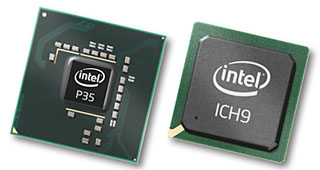
Tech Link (Chipset): Intel P35 Bearlake Motherboard And DDR3 Memory – Asus and Corsair

The lucky folks over at HotHardware managed to get themselves some cool motherboard and memory to play with. They have tested DDR3 and the newest motherboard from Asus with the latest chipset from Intel. They are pretty much happy with the results, check out the conclusion...


Performance Summary:
Over the course of our testing, we saw the new Intel P35 chipset and DDR3 memory combination offer up gains in the 2 - 5% range in various applications. This was largely attributed to the new Intel MCH and its improved access latency characteristics. There were several occasions where the P35 chipset driven Asus P5K3 Deluxe out-paced its 965 counterpart with the same DDR2 memory running in its DIMM slots. In terms of DDR3 memory, it's obvious the technology is still maturing somewhat but at its higher clock speeds, especially with a correspondingly higher FSB, there are significant gains to be had.


Intel's new Bearlake chipset family is off to a great start with the P35. Our first time out with this new chipset showed surprisingly good stability and performance with obvious headroom for growth. One look at a 1733MHz DDR3 clock speed and you can't help but get a little bit excited for what the future holds. The only caveat will be how quickly latency settings can be brought in line.

At this point in the game, if you were building a new system for work or pleasure, its probably doesn't make sense to spring for a DDR2 driven version of one of these new P35 motherboards, like the Asus P5K we tested. The product simply will have a more finite life-span with the inevitable migration to DDR3. In addition, DDR3 has a bit of growing-up to do for the next few months, so we'd recommend users wait and see what second generation products coming down the pipe will offer perhaps. Refinements in motherboard design are bound to be forthcoming, as well as tighter timings for DDR3.

Though, if you're itching for something to tinker with and spending a little extra cash on being an early adopter isn't out of the norm for you, we'd say jump in, the water is just fine. The P35 chipset with its snappy new memory controller impressed us more-so than many chipset product launches of late and we've seen plenty. What's perhaps more exciting is the upcoming X38 chipset with PCI Express 2.0 technology and a few extra lanes integrated with the chipset to boot. It's always hard to judge the entry point with a new platform but these are good problems to have.


Source:Intel P35 Bearlake Motherboard And DDR3 Memory – Asus and Corsair

Monday, May 07, 2007

Tech Link (Chipset): P35 "Bearlake": Asus P5K Deluxe and Gigabyte P35-DS3R Preview

While NDA for the chipset and actual products hasn't been lifted off yet, actual product pictures are now circulating around the net for some exposure. Of course, the missing piece across these product showcase are performance numbers. But hey, if you really like to see some early numbers, you can head on over here and here. For those asking me if I will still buy motherboard based on i965, the answer is it depends. If I already have a motherboard with this chipset, then I won't be buying another one based on the same, but will jump over to the newer one. However, if I still don't have any board based on this chipset and I need a new board now, then yes, I'm all over it. Anyway, check out the article over at neoseeker for some product tour of Gigabyte's and Asus' offerings of upcoming board.


Conclusion
While I'd love to tell you more about the P35 chipset, and Gigabyte's interesting P35-DS3R, along with the ASUS P5K family, those pesky little NDA's requires us not to reveal more until those NDA's are lifted.

But don't worry.

I'll be putting the P35, with both DDR2 and DDR3 memory through some serious torture testing to find out how well the P35 and DDR2 & DDR3 perform.

Frankly, I can hardly wait to find out if Intel has managed to outdo its excellent P965 chipset; and how well Gigabyte and Asus did on their first P35 implementations.


Source:P35 "Bearlake": Asus P5K Deluxe and Gigabyte P35-DS3R Preview

Thursday, April 26, 2007

Tech Link (Motherboard): ASUS Bearlake P35 Chipset DDR2 P5K Deluxe and DDR3 P5K3 Deluxe

AndreYang of XS manage to get his hands dirty with an upcoming Asus* motherboard. It looks really nice, with a new chipset from Chipzilla and supporting DDR3. AndreYang posted lots of pictures, but not benchmark results due to NDA. Be ready for some pic loving post over at XS, check it out...

Source:ASUS Bearlake P35 Chipset DDR2 P5K Deluxe and DDR3 P5K3 Deluxe

Sunday, April 15, 2007

Tech Link (Motherboard): Socket 775 Mobo Roundup

It's been quite some time since I last gave DriverHeaven a visit and boy do they change. The looks is a lot lot better now, and I love the theme. But if the looks changed, the quality is still the same, decent and meaningful articles still abound. And in one of the article, Intel's Bad Axe 2 motherboard is put to the test along with other enthusiast-level motherboard from NVIDIA* and AMD*. And guess what, Bad Axe 2 got the highest honor while AMD*s got the lowest score ;). Check it out...


Conclusion

Abit IN9 32X-MAX
Abit's flagship Nforce motherboard impressed from the moment it arrived on our desk. Abit's packaging is first class with just the right mix of style and substance. We were impressed with the sheer volume of bundled components and connectors which make the product ideal for those building a brand new system. Based on our past experiences with the 680i chipset we were more than a little worried that Abit wouldn’t be able to make a stable, bug free product (due to the choice of chipset), however following our time with the board we are happy to report that the IN9 32X-MAX suffers from none of the major issues which plagued the reference board (those issues included PS/2 compatibility, Sata controller issues and severe problems with memory compatibility).

That doesn’t mean that the board is without issue though and there are minor niggles such as random instability when too many BIOS options are changed in one batch as well as the bug in multiplier overclocking where only two of our quad CPU’s cores actually overclock. This only affects users with an extreme edition Quad CPU, however it is less than reassuring. We would hope that both issues are fixable because if they are resolved then we will be left with a great performance motherboard which has two of the best features we have seen in a long time (external CMOS reset and BIOS profiles).

Abit IN9 32X-MAX is available for £211 from OCUK / and $329 from Newegg

UPDATE: After we published this article we received a beta test bios from Abit with fixes for Quad core multipler overclocking. We will report back when we get time to test it thoroughly.


Intel D975XBX2
As we mentioned in our introduction to the XBX2 the original XBX served us well in our review systems in the past and we had high hopes for this particular product. By the end of our testing it was clear that Intel were on to another winner with the “2”. The board performed flawlessly during testing and its simple BIOS layout and ease of configuration mixed with performance close to Abit's motherboards are a great combination. It’s clear that when Intel are designing products they put a tremendous amount into the customer experience and unique features such as the BIOS config jumper and Intel’s incredibly easy update process really do give a great feeling of a quality product.

It was also nice to see that the ability to achieve high overclocks has not been lost between board revisions and despite the products mature age it still gives the latest and greatest a run for their money. Our only real criticism is that the memory support is now somewhat lacking (supporting up to DDR2-800) when compared to other similarly priced models.

Intel D975XBX2 is available for £164 from OCUK / and $240 from Newegg

Abit Fatality F-I90HD
The F-I90HD is a board that many people were waiting a long time for due to its use of AMD’s latest chipset however the overall feeling we got from using the product was that there was a lot of potential in the chipset which was being held back by design decisions. The ability of the board to reach 350+Mhz is very impressive for a M-ATX product, however we would love to see what the chipset is capable of within an ATX design featuring enhanced specifications. The lack of configuration in the BIOS was also disappointing to see with some key features, such as QX6700 upward multipliers being unavailable. There is also an issue with the time taken to save BIOS changes, or POST (when initially turned on) as it frequently seems to take an eternity. Performance of the board when up and running was great though and given the products placement at half the retail price of the other boards being tested today there is great potential for those on a budget to build a top performing PC around the F-I90HD.

Media Centre enthusiasts should also give the board some serious thought due to the silent design, small size and on-board HDMI port.

Abit Fatality F-I90HD is available for £76 from OCUK / and $124


Source:Socket 775 Mobo Roundup

Saturday, March 31, 2007

Press Release: SiS Announces Chipset License Agreement on Intel® Core™2 Quad FSB 1333MHz

This is good news. SiS has been a long standing player in the chipset arena and they aren't new to Intel hardware. They have been releasing really affordable chipsets, they have graphics, lan, and I believe even, audio solutions. They are known in the "affordable" line of products. Check it out...


SiS Announces Chipset License Agreement on Intel® Core™2 Quad FSB 1333MHz
Taipei, March 28, 2007---Silicon Integrated Systems (SiS), a leading supplier of core logic chipsets, today announced that it has signed a long-term licensing contract with Intel for the manufacture and sale of chipsets for the Intel® Core™2 Quad processor with 1333MHz front side bus.

SiS ' latest chipset license agreement with Intel demonstrates our working relationship and mutual cooperation.

"SiS will be offering the next generation products to support high-speed FSB 1333MHz for the Intel® Core™2 Quad processors," said Daniel Chen, the CEO and President of SiS, "These new chipsets will strengthen SiS product portfolios with another high-end option for consumers seeking extreme performance and innovative design."


Source:SiS Announces Chipset License Agreement on Intel® Core™2 Quad FSB 1333MHz

Saturday, March 17, 2007

Tech Link (Industry): CeBIT 2007: MSI motherboard roundup; nForce 680i with Creative X-Fi onboard; Intel 965 plus Crossfire;

Digitimes has a good coverage for the CEBIT2007. They posted a neat slew of motherboards from MSI*, with i965 and nForce chipset. Check it out...


The P6N Diamond combines some of the big names in enthusiast hardware; the nForce 680i – the current flagship chipset from Nvidia, and Creative's X-Fi Extreme Audio. This integrated version of the X-Fi series may lack some of the features that the add-in cards deliver, but for many the opportunity to have X-Fi onboard means lower costs and better performance than other integrated audio solutions. MSI mentioned that it has been working closely with Creative for over two years and the co-operation is working well for both parties.


Source:CeBIT 2007: MSI motherboard roundup; nForce 680i with Creative X-Fi onboard; Intel 965 plus Crossfire;

Friday, March 16, 2007

Tech Link (Chipset): Intel G965: mATX Performance Update

AMDTech has put the i965 chipset to some bench-loving test runs and came out with a decent findings. While I don't fully agree with their "Quick Take" kinda conclusion, it's still a decent read if you just want to see how mATX fairs against their ATX big brothers.


Quick Take

Our initial performance results indicate a toss up as to which solution is better. That was to be expected as we have two almost identical boards from a features and BIOS perspective that only differ in their use of chipsets and layout design. Even though the chipsets are different, they are based on the same core logic so any real performance differences would be derived from BIOS tuning, options, and the quality of board components.

While the G965 boards will never overclock as well as their P965 siblings, the base performance is almost identical if you have the ability to tune the board. This is a limitation of the chipset and not the mATX board design. On the AM2 side, we have already seen excellent overclocking results from the abit and DFI mATX boards and expect even better performance with their GeForce 7050 designs next month. Also, the performance differences between AM2 solutions in the mATX and ATX designs mirror our test results on the Intel platform for the most part.

We have a few mATX boards with the G965 chipset that have very limited BIOS options, but even so our initial performance tests only indicate up to a 2% difference in most test results due to the memory timings being the prime differentiator in the scores. In fact, probably the biggest difference we have witnessed in our game tests is 5% between a top tier P965 ATX board that has been tuned and a base level G965 mATX board from Intel utilizing auto settings. Our application tests vary from 1% to 3% in scores at stock CPU settings between the two boards with DDR2-800 memory.

In the end, we feel like your choice of a mATX or ATX solution should be dictated by the requirements of the system (price, features, layout, overclocking, warranty, etc.). The use of an integrated graphics chipset will not inherently reduce performance relative to a discrete graphics chipsets, provided you use identical components. It will be the other aspects - particularly overclocking if that's a concern - that will warrant the use of a discrete graphics chipset rather than an IGP solution.


Source:Intel G965: mATX Performance Update

Wednesday, March 14, 2007

Tech Link (Chipset): Intel P35 "Bearlake" Chipset Performance Preview

TweakTown manage to put together a preview of benchmarks for the upcoming Intel P35 chipset, codenamed BearLake. The chipset puts a good showing on the series of benchmarks, and it's looking like a killer chipset for the performance FanBoys. Check it out...


Final Thoughts
While we have only got our hands on the first working silicon of Intel’s P35 Bearlake-P chipset, we are extremely impressed with it so far.

Intel has put a lot of work into this chipset by the design of it, and with more on the way we can only hope things do get even better. Intel is looking like they are setting themselves up for a great run for the remainder of 2007 and into next year with their upcoming Yorkfield and Wolfdale processors. And with massive price drops on the horizon for upcoming Intel processors since all Dual Core processors will become mainstream parts making room for Quad Core as premium high-end, it’s only going to mean good things for Intel. For instance, the E6850 processor will debut with a street price around $266 USD which is around 75% cheaper than what the X6800 was selling for and you’re getting a processor platform which is able to perform faster.

One thing that was very limited in this silicon revision was its overclocking. By default the motherboard supports 333MHz FSB but we only managed to get it to 350MHz and this wasn’t 100% stable. This wasn’t anything to do with the board itself, as our board was supplied with plenty of overclocking tweaks, just that the chipset is of first silicon and not ready for full release yet. As we said, the P35 is based on 65nm process technology and once it’s fully ready for public consumption, we expect it to perform as least as well as Intel P965 in FSB overclocking.

Intel’s Bearlake will soon make its debut onto the motherboard market with the P35 first to market with the G33 and G35 soon to follow for the value segments. X38 will be the big thing but don’t expect that till late in Q3 of 2007 when DDR-3 memory is shipping.

Looking good so far!


Source:Intel P35 "Bearlake" Chipset Performance Preview

Sunday, June 11, 2006

Brag: Get the latest Intel® INF (Northbridge, Southbridge, and RAID drivers) for Conroe Motherboards

I got the latest INF that supports Broadwater chipset. It's a nifty software update, if you have any of the new boards out there that supports Conroe, and trying to find the best INF driver, then don't miss out your chance to get the latest one now! Of course, it supports ICH8/R as well, and yep, I also have that F6 driver for some NCQ-loving and RAID power for your Intel® Matrix RAID Storage technology support.

Yes, it supports all other "previous" generation chipset as well, such as your Intel® 945/955/975 series so you're not going to mess your OS or something like that. Of course, as with any driver installation ensure you have the proper hardware and software requirements, so don't go installing this on VIA-based motherboard. Download it here:

Intel® Chipset
Intel® Matrix RAID
Intel® F6 RAID

Thursday, June 08, 2006

Brag: Intel® Chipset Comparison

With the advent of Intel® Core™ uA, and of course, the processors sporting these uA, and then with the current mix of chipsets that seems to be supporting the new breed of processors, and then with a really varied and vast available of motherboards, many are asking: what is the best chipset to use?


It's a tough question actually, and mostly, it all boils down to the users needs, and of course, how OEMs and motherboard manufacturers incorporate these features. Right now, after the maturity of PCIe x16 support starting from the short lived i915 chipset, all succeeding chipsets, specially those that support dual core, have been showing promising performance already.

The i975 remains the cream of the crop chipset, and it offers great features, specially on the bandwidth it offers on graphical lanes. However, the performance doesn't come without a catch: it is the most pricey of all currently available chipsets.

The i945 still remains a very strong contender in the value series. The major drawback is that, it doesn't have native dual PCIe x16 slot, and if motherboard manufacturers indeed do implement dual PCIe x16, the 2nd implementation is often routed to the SouthBridge rather than the NorthBridge.

In any case, if you wanted to know more about the differences and similarities, as well as features, check out Chipzilla's website. I have added the link to the FanBoy tools as well.

Source:Intel® Chipset Comparison Page

Tuesday, May 30, 2006

Tech Link (MoDT): AOpen miniPC MP915-B Super Multi System Review

PCStats has a new review up on their site. And it's none other than a really cute and really attractive AOpen Mini PC. If you have been visiting my site and checking my HomeGrown articles about this particular Mobile on Desktop (MoDT) you'll know that, yep, FanBoy have reviewed this AOpen MiniPc for quite some time already.


There is little doubt that Small Form Factor (SFF) computers have revolutionized the way technology fits into the home, media room, and our lives. Yet as computers continue to advance by leaps and bounds, the whole the small form factor PC trend seems to be stuck on the initial chassis design Shuttle Computers first introduced in 2001. Now mind you, the toaster-sized SFF PC box isn't bad, it just doesn't fit into all situations.


Source:PCStats

Sunday, May 28, 2006

Tech Link (Chipset): NVIDIA nForce 590 SLI supports Intel® Core™ uA

Looks like NVIDIA* has something ready for the new breed of processors from Chipzilla. From the looks of it, it's going to be a force to be reckoned with. Aside from the "usual" SLI capability, NVIDIA* is offering a lot more this time around. Of course, the biggest news for this chipset, like I already mentioned, is the support for the processors based on Intel® Core™.


I just hope they make a good chipset this time, not only in paper, but in actual performance. I personally owned one of their current NF for Intel, an Asus P5ND2 SLI, and it was a nightmare even at stock settings. The motherboard has been replaced thrice(3x) and it will still not even become uber stable for me, that I have to ask for a full refund! My experience before sucks, so I am hoping that the new one will not suck so bad, and be great not just in their Flash animation and documentation, but in actual performance.

Another things I notice which I'd say is a minus is the 1066FSB settings. Unlike Intel chipsets, their stated maximum FSB such as 800MHz, is normally really not the maximum. Think of it as an artificial limitation, since, as experience shows, even before the time of i865P chipsets, these babies are capable of hitting 1200FSB! Now with my experience with Asus P5ND2-SLI, they did have a headroom, but not even enough to reach 1000FSB. Yes, literally, it can hit this FSB, but nowhere near the stability of Chipzilla chipsets.

Anyway, aside from that, it looks really great in paper. Here's the link to the technical specifications.

And oh, I added a demo of nForce® 500 on the left side of the site. Check it out.

Wednesday, May 03, 2006

Brag: I've got SLI driver for i975X :)

So a contact just sent me his i975X SLI driver. Too bad, another NDA so I can't share nor tell anyone where I get this from. It weighs in a measly 15MB, not too heavy I guess, considering how drivers these days soak up more than 20MB at the very least. I will have to set up my rig again to bench these babies out.

Anyway, I plan to bench an SLI rig on a D975XBX soon, I just need to find time as I already dismantled the baby since I am modding it to allow Conroe to work properly. Darn, too many toyz, so little time to play with. Till next bragging...

Sunday, April 30, 2006

Tech Link (Chipset): Intel® 975X Express Chipset = ATi Crossfire + NVIDIA SLI Ownage

It seems like it's a long time ever since I posted the info about the i975X supporting both dual graphics card technology. Back then, the motherboard hasn't been released yet, and supply of motherboards sporting i975 is still very scarce and rare.

But time passed, the motherboard based on this chipset has been released, and yet while ATi's Crossfire has been touted by OEMs, SLI is nowhere to be seen on the motherboard label or feature lists of the boards sporting dual PCIe x16 PEG. Enthusiasts has accepted the fact that to run SLI, and NVIDIA-based chipset supporting Chipzilla processor should be used, or so it seems back then.

Howeved, again, about four(4) days ago, I posted the sudden appearance of SLI on i975-based motherboard. This signals many doubts, questions, confusion, excitement, and some disbelief from the enthusiasts' community. However, while I also tried the older Forceware drivers, new ones seems to have completely removed SLI support and so this new emergence of SLI support is still hard (but exciting) to swallow.

But another one just pops up, this time, from coolaler, a respected enthusiast, showing SLI on Yonah with 7600GT. This is the final nail to the coffin, as all speculation and doubts are removed, and the interest is now shifted from "is it true?" to "how is it done?".

So with this new exciting information, the buzz word will now shift very much in favor of the very strong and flexible i975X chipset. Chipzilla rules!

Wednesday, April 26, 2006

Tech Link (Technology): i975 supports SLI

Ok, I personally have seen and tested a dual 6800 SLI set up with 66.81 driver and it works ok on a D975XBX. Though that was last year, I am not sure what happened to the next generation of video cards, and chipset drivers. In any case, as time passed by, the i975X only touts support for ATi's Crossfire solution, and nVidia fans are torn apart whether to get a crappy NForce4 for Intel or stick with the i975X.

In any case, in a Russian site, it was posted last year that an Asus P5WD2 can actually run on SLI configuration. Not many has reported it, in fact, I haven't really seen much about it. Maybe because of the fact that it didn't reach the top of the ORB, nevertheless, the score was impressive.

And then last week, FUGGER of XTremeSystems mentions that NVIDIA* will not support SLI on i975X because


"Intel chipsets do not provide enough bandwidth to support SLI"


In any case, Big_Sam made another splash when he posted another SLI-based score on a i975X board. This makes a lot of Chipzilla fans very excited, as the thought of Conroe with Crossfire and SLI comes sweeping thru their drool nerves.

So if i975 can support the newer NVIDIA* and ATi cards, it will be coolest play rig for the uber enthusiats: SLI + Crossfire, who would have thought such system exists? Intel really rocks big time!

Monday, April 17, 2006

Brag: First generation dual core supported on older i865 chipset

I have just been testing a new beta board and found some interesting tidbits. While I still haven't really gotten into the rigorous part of the test, the system is usable and I encountered no problem.

So far, I have tested four(4) processors and three(3) out of four(4) dual core processors work without a hitch. Since this is an i865 board, I'd like to emphasize that the video card is based on AGP and memory used is based on DDR1. Not that they are a compromise, AGP is still very strong right now though it will come short of Crossfire and SLI support. DDR is still a very good memory, though the lack of high frequency can be a "turn off" for some enthusiast, but my testing shows that DDR is still very competitive in the entry level segment for LGA775-based processor.

Anyway, the processors I've tested are:

  • Intel® Pentium® D 805/Smithfield

  • Intel® Pentium® D 820/Smithfield

  • Intel® Pentium® D 830/Smithfield

  • Intel® Pentium® D 840/Smithfield

  • Intel® Pentium® D 920/Presler


Except for the Presler core, the dual core works flawlessly. Who knows, a BIOS update may allow Presler core to be used. So for those using AGP and DDR1 memory, you do not have to pout for the lack of Dual Core support. The new baby will arrive sooner than you think.

And oh, did I mention that the new board enjoys the same OCability found on early i865 socket 478 boards? Except for the CPU socket, you can enjoy the previous luxuries of life: high end video card, cheap high capacity DDR, and yep, dual IDE channels for a total of four(4) IDE devices!

Thursday, March 30, 2006

Tech Link (Industry): NVIDIA Business Platform: A competitive desktop alternative to Intel?

Seems like NVIDIA* will try and mimic what Chipzilla has been doing for quite a long time already: Stable Image Platform. Of course, AMDroids are ignorant about this, well, most of them I would assume. Anyway, if this pushed thru, then NVIDIA* might be in a good market. They both have A* and I* covered.

What is a stable image platform? A stable image platform is essentially a standardized hardware and software solution that balances system performance and productivity against the need for greatly reduced administrative and support costs. A stable image program is generally based on a yearly cadence that includes a 3-month platform evaluation period, 12-month production cycle, and a 24-month support schedule.

The main advantage of this platform is in the design, qualification, and availability of a hardware and driver configuration that can be procured and deployed over a set 12-month cycle. This standardized hardware and driver configuration allows the IT group to design and deploy a software image that can be utilized throughout the 12-month production cycle without worry of compatibility issues between the hardware and software configurations.

Why is a stable image platform important? The ability to reduce and control the Total Cost of Ownership (TCO) for an organization's PC population over its life cycle is critical in today's IT department. Instability of the platform, lack of security, stability of supply, or varying hardware and software configurations can impose a tremendous cost and manageability burden within the IT department.

Although research numbers vary, it is generally assumed that only 20% to 30% of a PC's cost of ownership is attributed to the actual procurement and disposal of the platform. The remaining 70% to 80% of a PC's cost of ownership is attributed to the management of the platform over its life-cycle. These management costs are attributed to operational aspects such as training and energy, but the majority of costs are associated with the administration and management support of hardware/software upgrades across the network. Research has shown that by implementing a stable image platform program, it can reduce the life-cycle cost of a typical PC platform anywhere from 10% to 55% over a three-year period.

What are the benefits of a stable image platform? In an era where networked PCs have become a standard fixture in the majority of businesses, educational institutions, and governmental offices, the need to standardize and easily manage these platforms has increased exponentially over the past few years. The cost benefits of having a standardized platform program are significant for a typical organization at this time and are realized through a reduction of platform configurations, testing and qualification times, and simplification of PC management.

Since networks have become so prevalent within these market sectors, the ability to properly manage, maintain, and upgrade these systems is extremely important. When utilizing a stable image platform across the network, it greatly simplifies the ability of the system administrator to manage these assets from a centralized or even remote location. This leads to a reduction in administrative costs and the ability to quickly roll out minor patches, software application updates, or even new images without worrying about the hardware configuration. The result is a network of standardized PCs that are easily managed, stable, secure, and upgradeable for less cost than platforms consisting of multiple hardware and software configurations.

Other benefits include the ability to quickly roll out additional platforms if the user base increases or for replacement of older platforms. The purchase and storage of replacement platforms or components is greatly reduced based upon a common and stable hardware platform. The ability to upscale the base system by upgrading the CPU, memory, or installing a certified discreet graphics card for users requiring additional capabilities, yet retaining the same base platform and driver set, is an additional benefit.

Now, let's take a closer look at the features that the NVIDIA Business Platform offers and a comparative look at Intel's current and future offerings.

Source:AMDTech

Saturday, February 25, 2006

Tech Link (Chipset): Intel’s 965 Chipsets to Support Shader Model 3.0 – Roadmap

Not to be left behind in terms of technology and support, Chipzilla reportedly supports Shader Model 3.0 among other graphics technology.

Intel Corp.’s next-generation integrated graphics core will reportedly provide a lot of innovations among graphics capabilities, according to leaked slides from the company’s roadmap. Particularly, the new core that is to be found in Intel G965-series chipsets will sport new 3D capabilities as well as high-definition video acceleration.

Intel G965 core-logic will support Shader Model 3.0, including pixel shaders 3.0 and vertex shaders 3.0 as well as hardware decoding of WMV9b HD high-definition video streams. In addition, the new integrated graphics core from the world’s largest chipmaker will provide HDMI output, according to slides published by HKEPC web-site. It is unclear whether the new graphics core will support HDCP encryption as well.

According to the web-site, the first A0 samples of the Intel G965 graphics and memory controller hub (GMCH) have been out and their testing is complete. At this point Intel is reportedly testing the B0 samples of the chipsets, whereas the final C0 or C1 samples will be out in 14th – 18th week (May, 2006). The availability of the Intel G965 chipset is expected in the third quarter of the year.

Intel controls over one third of the graphics market. In particular, the company shipped over 37% of graphics solutions in Q4 2005, according to Mercury Research.

The new Intel G965 GMCH product will be the second mainboard-integrated core-logic solution supporting Shader Model 3.0 capabilities. Nvidia Corp. was the first last year to unveil its GeForce 6100 and 6150 solutions with similar feature sets, however, those chipsets were intended for processors by Advanced Micro Devices.


Source:XBitLabs