 Man, this is funny as heck. I believe it is fake, but if it's true, it's one funny technology. I know, I'll probably won't be jumping in to use this if it's true and if it ever came out. Though my opthalmologist advise me to blink 20x per minute, this guy is just awesome. Check it out...
Showing posts with label 3d. Show all posts
Showing posts with label 3d. Show all posts
Friday, January 21, 2011
Tech Link (Industry): 3D Without Glasses
Man, this is funny as heck. I believe it is fake, but if it's true, it's one funny technology. I know, I'll probably won't be jumping in to use this if it's true and if it ever came out. Though my opthalmologist advise me to blink 20x per minute, this guy is just awesome. Check it out...


Tuesday, August 10, 2010
Tech Link (Industry): Aiptek's 3D HD Camcorder and Portable 3D Display
 Woah, first time I have seen such products. Aiptek is going to release their new line of 3D-enabled products, namely 3D HD 720P Camcorder and Portable 3D Display. These are cool nifty toys, and are pocketsize, making it portable and handy. However, I find the product name too lame for its capability. The products are not released yet, but you can pre-order these products at Amazon, Sears, Target, Walmart, and B&H. That's right folks, US only! I don't know if and when they plan to released it in Asia.
 The 3D HD 720p Camcorder can record and capture stills and videos in 3D. It's got a built-in 3D-LCD for quick playback. Of course, it can also capture in standard 2D! The other toy, Portable 3D Display, also offers nifty features, because you can now watch and view pictures and videos without 3D glasses! I reckon it's something akin to those "3D" postcards I used to get when I was a kid. Aiptek said, they made it possible thru their "Parallax Barrier" technology.
Monday, July 26, 2010
Article: Fanboy's Feedback on The Last Airbender Movie
 I just saw The Last Airbender [in 3D] last weekend together with my kids. I decided to write a mini review to share my feelings about the movie since I am a fan of the animated series. I have always kept my eyes open for new episodes at Nickolodeon channel and Avatar: The Legend of Ang has always offered me fun and entertainment after a grueling work, or tasks from the office. It offers me a brief moment of solace and isolation from the world around me, as I engulf myself in the world of Avatar. I have come to like all the characters, and have always been looking forward for the next episode. So it's not a surprise that when a movie was planned, made, and shown, I am also one of the faithful that flock the cinema. I will now share my mini-review and my feelings after watching the movie.
Thursday, May 17, 2007
Tech Link (Benchmark): Rydermark Benchmark Preview
 Looks like there's an upcoming contender for FutureMark when it comes to 3D benchmarking standard. I haven't tested it personally, but from the pictures, I find the interface ugly. Madshrimps posted their review and they even posted a nice short video clip of the said application. Check it out....
The minimum requirements for the Rydermark benchmark are set at:
# 3.0GHz Single Core CPU
# 1Gb system RAM
# DirectX 9-class GPU with 128Mb RAM
# Sound card with support for DirectSound 3D
# Windows XP & DirectX 9.0c
For the time being Rydermark is a Windows XP/DX9 only benchmark, maybe DX10 in the future under Vista.
Rydermark comes with an interesting readme which gives a bit of background information on the benchmark:
# Can we relate the benchmark performance to actual games performance?
Absolutely. RyderMark is a technology demonstration of a racing game currently in development. It is NOT a synthetic benchmark. Just like the game, in addition to the GPU, the benchmark also stresses the CPU, audio and memory subsystems.
The graphics is powered by Sahara, our in-house DirectX 9 graphics engine. Audio is provided by FMOD Sound System (www.fmod.org) which has already been used in dozens of games titles. Therefore, every technology used in the benchmark is directly relevant to the game.
# Do you have different shaders for GPUs from different manufacturers?
ABSOLUTELY NOT. This is something we wish to make crystal clear. We run IDENTICAL shader code on GPUs from all hardware manufacturers.
To reiterate the point, one of the main reasons we can stake the claim for creating a truly impartial and fair benchmark is the fact that we do not favor any hardware manufacturer over another by supporting obscure or optional texture formats or features in DirectX.
# How is the final RyderMark score calculated?
The final benchmark score is calculated as follows:
RyderMark Score = 20X Maximum Frame Rate + 40X Minimum Frame
Rate
# Why do you value the minimum frame rate much more than the maximum frame rate?
From our perspective as a games developer, we place a very high value on smooth gameplay. This requires a minimum of 30 frames per second at all times. At the same time, peak frame rates over 60 frames per second make no discernible difference to the gameplay experience.
Therefore, we urge users to look closely at the minimum frame rate as well as the overall score. PCs which fail to deliver a consistent minimum 30 frames per second may not provide an enjoyable gaming experience in next generation games.
# Can you describe some of the different shaders and technologies used in RyderMark?
These are some, but not all of the techniques used in the benchmark:
- Parallax Occlusion Mapping
- Motion blur
- Depth of field
- Soft shadows
- 32-bit and 64-bit HDR Lighting
- Fully dynamic lighting
- Intensive particle effects
- Dynamic reflections
- Refraction
- Normal mapping
Source:Rydermark Benchmark Preview
Friday, May 04, 2007
Press Release: New NVIDIA GeForce® 8800 Ultra Enables World's Fastest Gaming Platform
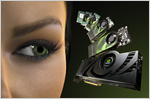 It's a bit late I know, one day late but better later than never. NVIDIA* released their newest card in preparation to combat whatever AMD/ATi has up their sleeves to release this month. But this new Ultra is going to cost uber high, up there with a high end Intel CPU. For some reason, it is priced so high even with just a frequency bump with no difference compared to existing and current 8800GTZ model in temrs of stream processors (128), texture mapping units (32), raster operations (24) and same memory bus width of 384. Expand to read the official press release...
New NVIDIA GeForce® 8800 Ultra Enables World's Fastest Gaming Platform
For further information, contact:
Brian Burke
NVIDIA Corporation
(512) 401-4385
bburke@nvidia.com
FOR IMMEDIATE RELEASE:
SANTA CLARA, CA—MAY 2, 2007
News Facts:
- Today NVIDIA Corporation (Nasdaq: NVDA) introduced the world's fastest graphics processing unit (GPU), the NVIDIA GeForce 8800 Ultra.
- The NVIDIA GeForce 8800 Ultra performs an average of between 10 and 15% fasteri than the GeForce 8800 GTX GPU, previously considered the fastest GPU on the planet,ii across a wide range of top games and applications.
- NVIDIA nForce® 680i SLI-based motherboards for Intel processors provide the fastest and most feature-rich platform for the GeForce 8800 Ultra. NVIDIA refers to these systems as the "definitive gaming platform."
- Consumers will be able to experience high-resolution, visually rich gaming and high-definition video playback with support for Blu-ray and HD DVD content.
- Definitive gaming platforms built with any nForce 600 Series motherboard are forward compatible with the new Intel processors with support for 1333FSB technology.
Product Facts:
- Graphics cards equipped with the NVIDIA GeForce 8800 Ultra GPU and 768MB of video memory will be available at e-tailers and retailers worldwide by May 15th. NVIDIA GeForce 8800 Ultra graphics card launch partners include Asus, BFG, EVGA, Gainward, Galaxy, Gigabyte, Innovision, Leadtek, MSI, PNY, Point of View, Sparkle and XFX.
- Prices range from $829 and higher. GeForce 8 Series GPUs are the first shipping DirectX 10 GPUs and are the reference GPUs for Microsoft DirectX 10 API development.
- GeForce 8800 GPUs are the developer's platform of choice for this year's top DirectX 10 titles, including Lost Planet: Extreme Condition, Crysis, Age of Conan, Hellgate: London, Company of Heroes: Opposing Fronts, World in Conflict, BioShock, PT Boats, and Cryostasis.
- Developers creating next-generation OpenGL titles, such as Enemy Territory: Quake Wars are also using GeForce 8 Series as their development platform of choice.
- GeForce 8 Series GPUs include all required hardware functionality defined in the Microsoft Direct3D® 10 specification, with full support for the DirectX 10 unified shader instruction set and Shader Model 4 capabilities.
- DirectX 10 is included with Microsoft Windows Vista and delivers unparalleled levels of graphics realism and film-quality effects for games, all rendered in real-time on a GeForce 8 Series DirectX 10-capable GPU.
Quotes:
Attribute to Ujesh Desai, general manager of desktop GPUs at NVIDIA:
"The definitive gaming platform is built around the fastest components available and today there is no disputing those components include the GeForce 8800 Ultra GPU and an NVIDIA nForce 680i SLI-ready motherboard. The graphics industry evolves extremely quickly and it is quite an achievement when you can leapfrog your own performance milestones in succession like we have done with these GeForce 8 Series GPUs."
Attribute to Glen Robson, general manager of Dell gaming products
"Dell is deeply committed to designing PCs that cater to gamers' needs and desires and offering the latest and greatest GPUs is a key technology differentiator. NVIDIA GeForce 8800 Ultra GPUs deliver stunning performance gains today and support the key features that will facilitate an awesome visual experience on DirectX 10 titles."
For more information, please visit http://www.nvidia.com or listen to the NVIDIA podcast located at http://download.nvidia.com/podcasts/pr/050207_geforce_8800_ultra.mp3.
Source:New NVIDIA GeForce® 8800 Ultra Enables World's Fastest Gaming Platform
Wednesday, April 25, 2007
Rant: ATI Radeon HD 2900 XT Performance Benchmarks
 Ok, this is not a Tech Link for a reason, and it's just my random rant. I happen to stumble upon this AMDtech news bit (yes, yes, I know it's DailyTech) from XS. It is about AMD's upcoming video card, and no, that's not my rant, but before I post my rant, let me quote part of the news bits:
Onto the benchmarks. The tests were conducted on an Intel D975XBX2 BadAxe2, Intel Core 2 Extreme QX6700 and 2x1GB DDR2-800 MHz. The operating system on the test system was Windows XP, with a fresh install before benchmarking each card. Testing of the AMD ATI Radeon HD 2900 XT was performed using the 8.361 Catalyst RC4 drivers, while the GeForce 8800 GTS used ForceWare 158.19 drivers.
I bolded the items which I wanted to emphasize. So here's the rant: why would AMD used a Bad Axe 2, of all the boards capable of CrossFire? And didn't ATi already have their very own chipset that supports CrossFire with an AMD CPU? Or if I am mistaken, I know there's a board for Intel that has an ATi chipset that can support Crossfire and quad core (Fatal1ty F-I90HD) so why not this one instead? And even if they really prefer i975, why not Asus for such demo?
I know that they can use anything they like, but I just find it odd that of all the possible alternatives, they end up with a competitor's board, and chipset, not to mention, processor.
Update (04/26/2007): Apparently, DailyTech is the one running the benchmark. I am really not sure, because their first paragraph is as clear as mud and can be very easily mis understood:
After several delays, AMD plans to launch its long-awaited R600 graphics processors. AMD is currently briefing select members of the press on its R600 architecture in the Tunisia, but there is no embargo date on the R600 for DailyTech -- we can show you benchmarks now.
Anyway, here's the update that makes it much clearer now:
* Our benchmarks for Half Life 2: Episode 1 showed an abnormal framerate for the NVIDIA GeForce 8800 GTS card that scaled with lower resolutions -- we believe there was a copy error. We reran the tests this morning and achieved 119.2 frames per second with the GeForce 8800 GTS.
Wednesday, April 18, 2007
Article: The Journey with Intel® Core™ 2 Duo E6320, An Uphill Battle! (Part II)
 This is the second part of the article I started a couple of days ago. If you haven't seen it yet, I suggest to check it out as I have put in lots of information in there. I have also submitted my 3DMark06 score over at hwbot.org, and sadly, it never really got too far.
While the previous overclock reached was 50% above nominal, the score is not enough to be a stand out. Compared to other processors, it would seem that 50% is still relatively conservative. However, with the current memory that I have, the default speed it runs is at DDR2-800MHz. Apacer* really worked well, and it served me well till I hit a wall at 450MHz FSB or DDR2-900MHz. No matter what voltage and cooling I tried, it won't get stable enough to complete 3DMark06. At 2.4v with timing of CL5-5-5-18, stability is a big question. For this reason, I am forced to change strategy and tore open an OCZ DDR2 PC2-6400 Platinum Revision 2 Dual Channel memory.
 Memory: While I always drool for two sticks of 1GB OCZ DDR2 PC2-7200 Special Ops Edition, lack of $$$ and availability prohibited me. If not for FUGGER of XS, I would have not been able to acquire this memory, free of charge. Thanks FUGGER and XS, you and the forum rocks! Anyway, back to the memory, it has a pretty good timings of CL4-4-4-15 at DDR2-800MHz at 1.9v. It'll be the first time I'll be using this memory and it's fresh right out of the box. I am expecting it to perform much better than Apacer Value RAM. As such, let me report the new test set up:
Test Set Up
Processor Intel® Core™ 2 Duo E6320(1.86GHz) Dual Core
Motherboard: Asus® P5B Deluxe BIOS 1011
Memory: OCZ DDR2 PC2-6400 Platinum Rev2 2x1024MB(CL4-4-4-15 SPD)
Hard Drive: Seagate* Barracuda 120GB SATA RAID 0
Video Card: Asus® 7900GTX 512MB v93.74
Power Supply: Delta 670W EPS12V (server grade)
Chassis: N/A
Ambient Temperature: 35c
::Overclocking and Benchmarking Notes::
After reaching 50% overclock, the next target would be 75% overclock of 465MHz FSB. At this stage, overclocking is already beyond all the nominal settings, from the processor, to motherboard, to memory. Previous settings of 399MHz still puts the memory at its nominal speed, and at this speed, the memory will now run way above stock of DDR2-930MHz from DDR2-800MHz. The processor and motherboard is overclocked by ~75%, while the memory is running ~16% at this settings.
While it would seem that the system is holding out, the main challenge is the ambient temperature which is now hitting 35c to 36c which is way too hot. This will definitely be interesting to see if the 75% overclock on the motherboard and processor, and 16% overclock on memory will survive the rigorous benchmark runs.
Aside from adjusting the vCore manually to 1.3v, the vDimm is also set at 2.1v. All other settings on the motherboard are still left at their default or "auto" values.
::Benchmarks::
Gaming:
Doom3: Low Quality-640x480

3DMark Benchmarks:
3DMark01: Overall

3DMark03: CPU

3DMark05: CPU

3DMark06: CPU

Aquamark03: CPU

Multimedia/Multitasking/Multithreading Benchmarks:
Cinebench: Render Score

Cinebench: Render Time

PCMark05: Overall

SANDRA: CPU

SANDRA: Multimedia

wPrime: 32M

SuperPi: 1M

Memory Benchmarks:
SANDRA: RAM Bandwidth

Others:
WinRAR

Temperature

Loaded Temperature Screenshot

::Closing Thoughts with 75% Overclock::It is clear that all the components in my possesion are a gem to behold. The processor is holding out at such 75% overclock, with a mere 1.3vCore and aging Thermalright XP90 cooler. The motherboard never seems to be giving any hiccups and has been a stable platform. And the memory is just showing its fangs at overclocking. Stay tuned as I continue to push this processor, motherboard, and memory! Till next installment, enjoy the benchmark results...
Monday, April 16, 2007
Article: The Journey with Intel® Core™ 2 Duo E6320, The Hardest Step is The First Step...(Part I)
 This processor, Intel® Core™ 2 Duo E6320, has been showing now on many online stores in the US and soon, it will be the same in many countries. While I already got this processor for quite some time, I never really had a chance to play with it seriously, and most of the time, I am only able to do stock benchmarks. At one time, I did manage to put more energy into overclocking it but still, I never gave this processor enough justice by being jumpy with my overclocking. I know I could have done better if I just give it more thought, and this time around, I will be spending quality time to push this baby.
Disclaimer: This is an ES CPU, retail may or may not have changes from this sample.
Goals and Objectives: The primary goal of this overclocking experiment is to complete a benchark of FutureMark®'s 3DMark06 with stable processor overclock, without lowering the multiplier from nominal 8x, no solder modding on the board and costly cooling requirements.
Success Indicator: There will be four(4) success indicators:
- Completion of 3DMark06 benchmark
- Reaching stable overclock on two cores
- Stable multi-threaded Prime95 with aircool heatsink for at least 5min
- Zero Physical Changes on the hardware (no solder mod, no lapping, etc)
::Processor Specifications::
The Intel® Core 2 Duo™ E6320 has the following specifications:
- sSpec: ES^
- Frequency: 1862 MHz (1.86GHz)
- Core: Conroe
- Process: 65nm
- Package: LGA775
- Core Voltage: 1.19v
- Bus Speed: 266MHz
- L2 Cache: 4096KB
- Multiplier: 7
- Stepping: B2-6
- Thermal Specification: 61.4°C
- Thermal Guideline: 65.0W
- Platform Compatibility: 06
- EM64T: Yes
- Execute Disable: Yes
- Hyperthreading Technology: No
- Virtualization: Yes
- Core per Package: 2
- L2 Cache per Core: Shared 4096KB

Test Set Up
Processor Intel® Core™ 2 Duo E6320(1.86GHz) Dual Core
Motherboard: Asus® P5B Deluxe BIOS 1011
Memory: Apacer Value DDR2-800MHz 2x1024MB(CL5-5-5-18 SPD)
Hard Drive: Seagate* Barracuda 120GB SATA RAID 0
Video Card: Asus® 7900GTX 512MB v93.74
Power Supply: Delta 670W EPS12V (server grade)
Chassis: N/A
Ambient Temperature: 34c
::Benchmark Methodology::
For benchmarking, at least three (3) runs will be made for each benchmark. From the scores, the lowest and highest score will be discarded, reducing the random spike in results and ensuring better consistency of results. Note that more than three (3) benchmark runs can be executed to validate any inconsistency or abnormality that may arise.
For temperature gathering, Core Temp Beta 0.95 will be used along with SpeedFan v1.32 and the motherboard's own software. From the readings of all three software, assuming they all worked, an analysis will be done to derive the most accurate temperature reading. An external temperature reader, Coolermaster Aerogate II, will be used as well for additional reference. For multicore system, the temperature reading for both idle and load will be based on the highest reported temperature of all the cores.
 Heatsink/Fan: Due to lack of funding, there will be no water cooling, or phase change from this Blog article and as such, part of the success indicator is just aircooled-based heatsink. The best I could muster is an aging Thermalright® XP-90 with a Delta® brushless fan model FFC0912DE (1.5a) and an LGA775 retention mechanism. I have no other heatsink available except the stock reference cooler. Thermaltake® Big Typhoon, Sunbeam® Tuniq Tower, Sycthe® Ninja Plus, Zalman® CNPS9700 or even Coolermaster® GeminII are all great heatsink, and arguably, the best right now in the market but availability and most importantly $$$ is scarce right now. But hey, I have used it in my Prescott days, so it should perform equally well (fingers crossed).
 Motherboard: The motherboard selection is not much of a debate here, Asus® P5B Deluxe is selected as the motherboard of choice. While performance is far from equal compared to their i975 brethren and manual selection of bootstrap is not possible, the capability of this board to hit 400MHz FSB and beyond is unquestionable. However, like many other Asus® boards I have tried before it, this one also suffers with severe voltage drop of the vCore. This will be remedied with a vDroop pencil mod.
 Memory: Apacer® memory will be used for now, as the ample size of 1GB on each module will hopefully be enough to boost 3DMark06 score. While this may not seem like a good choice, 400MHz FSB is really not that low, considering the size of RAM and timing that go with this RAM.
 Hard Drive: Two Seagate® 160GB SATA/3Gbps/8Mb will be used and configured as RAID 0 using Intel® Matrix RAID configuration with their ICH8R chipset. Not the fastest, but it's the most reliable and compatible that I have used so far. The hard drive will be partitioned in two, one will be for the OS installation, and the other partition will just be for miscellaneous data.
 Video Card: Since 3DMark06 is targetted, I decided that an Asus® 7900GTX/512MB is good enough, besides, that's the best I have right now since my 8800GTX is already returned from loan. The driver is the latest (dated November 2006) downloadable for this video card at the time of testing. No tweak is done on this video card, and operated on stock. However, I will be tweaking this if score is ruining the magnificence of the processor.
 Power Supply: A Delta® 670w model DPS-670DSB REV: S2. It's a full featured power supply and actually stable enough to run even server processors. It's an industrial grade power supply, and would be more than enough for my specifications.
Chassis: The testing will be done on an open test bed so there will be no chassis.
::Overclocking and Benchmarking Notes::
There's not much sense in running this processor on stock, as I have already put this processor to several tests, however, the stock benchmark will be used to compare the results. The initial overclock will be pushed to 50% above nominal, so that will be at 2.793GHz. Not that high, but at this clock speed, the memory will already be reaching its stock speed of 400MHz or DDR2-800MHz (well, actually 50% is 399MHz so it's 798MHz). This will be good to start benching away and produce some good numbers.
Memory timing is set to CL4-4-4-15, with a measly 2.00vDimm. A fan is already put in place on top of the memory just to make sure I don't forget cooling them.
I will be focusing on 3DMark06 for now, and later on, I will update this Blog post for other benchmark results. Note however, that since I am not a Pro* user of FutureMark benchmarks, each time I submit a new score, the link will not be updated. In that case, check the latest Blog post on this subject matter to find out the latest score. This will happen since I will be finding the best settings to achieve a good 3DMark06 score.
3DMark06: 6,337
3DMark05: 11,370
3DMark03: 25,439
3DMark01: 45,864
PCMark05: 7,614
::Benchmarks::
Gaming:
Doom3: Low Quality-640x480

3DMark Benchmarks:
3DMark01: Overall

3DMark03: CPU

3DMark05: CPU

3DMark06: CPU

Aquamark03: CPU

Multimedia/Multitasking/Multithreading Benchmarks:
Cinebench: Render Score

Cinebench: Render Time

PCMark05: Overall

SANDRA: CPU

SANDRA: Multimedia

wPrime: 32M

SuperPi: 1M

Memory Benchmarks:
SANDRA: RAM Bandwidth

Others:
WinRAR

Temperature

Loaded Temperature Screenshot

::Closing Thoughts with 50% Overclock::This is an early benchmark, and the score will continue to evolve as I try to find the sweet spot with the processor, motherboard, memory, and of course, video card. For now, enjoy the score, no matter how low it may seem to be. I will post the next installment of the journey in the next upcoming blog posts...
Subscribe to:
Posts (Atom)