 Apparently, a leaked performance of AMD's upcoming architecture (Bobcat) shows that it has "good" performance against Intel's Atom D510. However, I am really not sure what the graph shows since it says on the right most column under the heade "Speed-up" (vs Ontario), Atom D510 shows 0.58x. The rest of the column, from top to bottom, shows 1.15 (vs Athlon II X2 250u) and 2.42 (vs Phenom II X4 965BE). If I am to read that, Atom is 0.58 faster than Ontario. Oh well...
Showing posts with label intel vs amd. Show all posts
Showing posts with label intel vs amd. Show all posts
Sunday, August 01, 2010
Tech Link (CPU): AMD Ontario performance numbers leaked
Apparently, a leaked performance of AMD's upcoming architecture (Bobcat) shows that it has "good" performance against Intel's Atom D510. However, I am really not sure what the graph shows since it says on the right most column under the heade "Speed-up" (vs Ontario), Atom D510 shows 0.58x. The rest of the column, from top to bottom, shows 1.15 (vs Athlon II X2 250u) and 2.42 (vs Phenom II X4 965BE). If I am to read that, Atom is 0.58 faster than Ontario. Oh well...

Wednesday, June 27, 2007
Tech Link (Industry): Too Terrible To Contemplate? . . .
 I decided to give overclockers.com to see what the usual doomsday predictor (for both A* and I*) have posted on their site. While I am amused with their article, I never really used them as a "factual" source, but hey, I am not saying they are claiming, it's just my "feelings".
Anyway, I read one of author's musings and somehow, this reflects how I feel with A*. There's not much news, and early benchmarks are just for early samples, not too many hard evidence to say how A* will respond. Expand to read more...
There's been a lot of bad news about AMD this year, but a lot of people don't want to hear it.
I'm not talking about fanboys, but those who essentially say, "My God, AMD's got to pull through, because if they don't, that would be bad for me!" (OK, they usually say "us" but it boils down to the same thing.)
Source:Too Terrible To Contemplate? . . .
Thursday, June 21, 2007
Tech Link (Processor): Celeron 430 @ 3ghz vs FX-57 @ 3160mhz , the new Celeron rocks
 PcCI2iminal of XS has posted a head to head battle between a Celeron (which I posted so long ago already) and an FX-57. And guess who won? Well, it's a FanBoy site so you'll probably know it's the Cely :)...
How the title says:
Celeron 430 @ 3ghz vs FX-57 @ 3160mhz
Cinebench
Celeron 430 -> 473
FX-57 -> 435
Source:Celeron 430 @ 3ghz vs FX-57 @ 3160mhz , the new Celeron rocks
Saturday, June 16, 2007
Press Release: AMD’s presence in workstations plummets in Q1’07, reports Jon Peddie Research
 It's a bit late to post this, but still very interesting newbits. Over at JPR, they have a table that shows the MSS of Intel vs AMD head-to-head. In Q3'05, AMD is steadily gaining MSS at this segment, from 6.6% to 13.3% on Q2'06. But on Q1'07, AMD's MSS is reduced to 8% and Intel enjoys 92% of the MSS. Expand to read the full story..
EDITOR'S NOTE: Excerpts from the JPR Workstation Report and expert interviews are available on request.
AMD’s presence in workstations plummets in Q1’07, reports Jon Peddie Research
TIBURON, Calif—June 13, 2007—Times change, and they can change fast. As 2006 began, Intel’s Xeon was in a tailspin, while AMD’s Opteron could do no wrong. In the robust market for workstations, the roles have since reversed, with first quarter results reported from Jon Peddie Research showing Xeon has grabbed back much of the share it had lost to Opteron.
The workstation market remains strong
Overall, the workstation market continues to pleasantly surprise. As expected, quarterly growth rates have subsided a bit from the 25% to 35% increases (year-to-year) JPR had seen in late ’05 and early ’06, but they remain strong. All told, the industry shipped 674 thousand workstatioßns in the first quarter of 2007, up 15.2% over the same quarter of 2006. ASPs held flat, allowing revenue to also increase a healthy 15% to around $1.7 billion.
Intel stealing back the share it had lost
In workstations, Opteron had been steadily draining share from Intel’s Xeon, peaking at over 13% of dual-socket platforms for Windows-compatible workstations in Q2’06. But Q2’06 not only market the peak of Opteron’s incursion, it marked the beginning of a significant fall. JPR reports that in Q1’07, AMD’s share of the dual-socket capable segment (where Opteron was strongest) didn’t simply flattten but actually dropped by over 50% year-to-year.
Vendor
Q3CY05
Q4CY05
Q1CY06
Q2CY06
Q3CY06
Q4CY06
Q1CY07
Xeon
93.4%
90.9%
87.6%
86.7%
89.1%
88.9%
92.0%
Opteron
6.6%
9.1%
12.4%
13.3%
10.9%
11.1%
8.0%
Table 1. Xeon vs. Opteron in market for dual-socket, Windows-compatible workstations
“We’d expected AMD’s share to moderate or level off by the time Intel improved its dual-socket Xeon platform in mid ’06, but we hadn’t anticipated the decline we’ve seen,” commented analyst and JPR Workstation Report author Alex Herrera. “The extent of Intel’s rebound will put that much more pressure on AMD to deliver quad-core Barcelona soonand with better performance than Xeon.”
In the overall workstation market (including higher-volume single-socket systems), AMD had risen to a peak of 3.6% in Q2’06, contracting to 2.0% in this last quarter.
About the JPR Workstation Report
Now in its fourth year, JPR’s Workstation Report - Professional Computing Markets and Technologies has established itself as the essential reference guide for hardware and software vendors and suppliers serving the workstation and professional graphics markets.
Subscribers to the JPR Workstation Report receive two in-depth reports per year providing a comprehensive analysis of the vendors and technologies driving the workstation platform. Clients also receive four quarterly reports detailing and analyzing market results for each calendar quarter. For information about purchasing the JPR Workstation Report, please call 415/435-9368 or visit Jon Peddie Research at http://www.jonpeddie.com.
About Jon Peddie Research
Dr. Jon Peddie has been active in the graphics and multimedia fields for more than 30 years. Jon Peddie Research is a technically oriented multimedia and graphics research and consulting firm. Based in Tiburon, California, JPR provides consulting, research, and other specialized services to technology companies, including graphics development, multimedia for professional applications and consumer electronics, high-end computing, and Internet-access product development. Jon Peddie's Market Watch and First Look are quarterly reports focused on the market activity of PC graphics controllers for mobile and desktop computing.
Source:AMD’s presence in workstations plummets in Q1’07, reports Jon Peddie Research
Thursday, June 14, 2007
Tech Link (Platform): Vigor's Quadfather Uses AMD Quad FX CPUs
 THG has an article posted about a AMD's 4x4 platform. We all know that this platform sucks and some of you might be thinking why post AMD things. Well, I am a Fanboy and if I see Intel products beating AMD's crap to a pulp, you'll see me post it here for sure. And this one is pretty good, if you're an AMDroid who is a masochist who likes torturing yourself, then get this platform. Otherwise, rejoice and just go a single-chip solution quad-core from Intel and have fun poking at the poor green bloke. Expand to read what THG has to say, or just read this excerpt:
We can't fault Vigor for building a system using inferior processors when these are the best an AMD enthusiast can buy. Instead, we'll put the blame on AMD for not keeping pace with the competition, and hope for a quick turnaround as new products are released.
Conclusion
If one were to add up everything Vigor Gaming put into its Vigor Force Recon QX4, its $4,900 price appears reasonable. Yet the 54% performance gain from Dell cost only 46% more. For anyone with an extra $2300 to spend, the Dell appears to be a better deal without even considering peripherals.
The Vigor Force Recon QX4 doesn't include a monitor it its base price. The Dell we tested included its 2407WFP 24" LCD monitor, a $670 value. Deducting that, the Dell system actually cost only 33% more, for a 54% performance gain.
We can't fault Vigor for building a system using inferior processors when these are the best an AMD enthusiast can buy. Instead, we'll put the blame on AMD for not keeping pace with the competition, and hope for a quick turnaround as new products are released.
Source:Vigor's Quadfather Uses AMD Quad FX CPUs
Wednesday, June 13, 2007
Tech Link (Processor): Clovertown versus Barcelona
 RickGeek of Geek.Com posted an interesting opinion about native versus mcm. In his post, the author cited many advantaged/disavantages of Clovertown MCM versus the competition's so called offering. And the truth isn't very hard to see, Intel has been shipping millions of quad core processors while AMD has yet to ship one. And I don't mean sample, Intel is shipping retail products, just in case you're not aware yet, and AMD is still delaying their Barcelona release. This processor better perform or it will be a major dissapointment even for a FanBoy like me...
OPINION
When I first heard about AMD's decision to make a native quad-core processor--that is a single piece of silicon comprising all four cores--I thought it was an excellent idea. I began to think of the advantages four-way HyperTransport has over the shared bus architecture of Intel's design. I also saw the significance in the larger shared cache, especially when all four cores are working closely on some particular task, and I didn't really see any downside. However, the more I think about it, the more I am realizing how much better Intel's solution is.
Clovertown is a single-package solution comprising two dual-core Core 2 processors within. It uses a shared bus architecture and is somewhat slower in off-chip communication, but because the die is so much smaller, they can create a larger shared cache for each dual-core, thereby making up for much of that loss.
AMD is not at the same place in manufacturing prowess that Intel is. It has been reported that Intel's yields are also very high, typically 90% or higher with some reports saying 95% or higher. AMD's yields have never (to my knowledge) been publicly disclosed, though I'm going to make a probably very incorrect assumption that they're around 80% for current processors. Even assuming they were 95% for current processors, we know that the number of potential defects goes up by the square of the surface area, so as we move from K8's current 183 mm^2 dual-core 65 nm 512 KB L2 processors, we would see a significant degredation in potential yield due to an additional 100 mm^2 per die alone. That also does not include the potential loss of high-binning parts due to even small defects not making the chip unusable, but rather making them less clockable at higher speeds.
We now know that Barcelona's die will be 283 mm^2, and that Clovertowns are comprised of two 143 mm^2 dual-core dies. Using my Wafer program, we find that AMD could fit a maximum of about 212 Barcelonas per 300 mm wafer, while Intel could fit about 430 dual-core Core 2 processors on a single 300 mm wafer. Now, assuming a 90% yield for Intel, that's about 388 dies per wafer, or 194 Clovertowns. In order for AMD to make as many Barcelonas per 300 mm wafer, its yield would have to be 92%, and by all accounts that's not something AMD will be able to do 1) based on its unconfirmed history of lower yields, 2) based on the natural increase in defect rate due to the larger die size and 3) that defects of any kind which do not render the chip inoperable will render it operable only at slower speeds.
AMD is facing several realities here with its native quad-core design, and it would seem that it does not have the manufacturing prowess to pull it off. Some at Intel even admitted recently that the company would have a hard time doing a die that large with high yields. Note also that Intel's Itanium at its largest on an 180 nm process technology was about 473 mm^2, quite a bit larger. I believe that also might explain why Intel targeted the highest-end markets with Itanium--because those processors sold for so much that very low yields would still be profitable.
As we stand today, with a pricing war going on between Intel and AMD, this native quad-core does not seem to provide enough financial incentive for AMD to have gone with it, even with its potentially much higher performance and scalability.
I see no two ways about it; I think AMD has made a significant mistake in going with the native quad-core design. Had it gone with an approach similar to Intel's, the company could've already had single-package quad-core parts out the door, and their yields would've been greater, their processing power would've only been slightly slower, and they could've been more price competitive.
As it stands, I just don't see the advantages of a native quad-core design. However, I'd very much like to hear your opinions.
Please post your thoughts below.
Source:Clovertown versus Barcelona
Monday, June 11, 2007
Tech Link (Technology): Intel discusses quad-core processor server market
 An interview with Intel GM for Server Platforms Group is posted by Digitimes and in that interview, the GM mentioned his thoughts about the competition's native quad core future offering. Expand to read the Q&A...
Shawn Chen, Taipei; Joseph Tsai, DIGITIMES [Friday 8 June 2007]
With AMD and Intel pushing their quad-core server processors at Computex Taipei 2007, Digitimes got a chance to talk to Boyd Davis, general manager of server platform group marketing of Intel to discuss Intel's plans and thoughts about the new quad-core processors.
Q: What was the main factor that caused Intel to bring its 45nm Harpertown server processor forward to this year?
A: Intel's product launch is directed by the demand of clients, which has nothing to do with the competition in the market. Currently, product development is almost complete therefore it is natural for the company to launch the Harpertown processor ahead of schedule. The company expects to mass produce the processor in the fourth quarter this year.
Q: In the current server market, competition among CPU makers over semiconductor technology has boosted the migration rate of new platforms. Can the enterprise market catch up in technology?
A: In the past, the server product lineup had a slow migration rate due to the long research time in developing the processor. However, with the assistance of nanometer processing, CPU technology now can advance faster, which shortens the product manufacturing time, sequentially. Intel used to have CPU as the unit for server migration in the past, but is now using platforms. The current platform is expected to last until Penryn processor launches in the fourth quarter.
Q: What are Intel's thoughts about the delay of AMD's native quad-core processor Barcelona?
A: AMD's so-called native quad-core processor has a difficult challenge in technical and manufacturing terms and even Intel would have difficulty facing such challenges. Intel currently still adopts two dies on one chip for its Harpertown processor. The technology is much easier, the product has higher yields and performance is almost the same as the native quad-core processor. Therefore, Intel will continue to use this design in 2007.
Q: With the server market currently crossing over several different fields, besides the enterprise sector, in what markets do you expect to see good performance?
A: Other than the enterprise market, HPC (high-performance computer), blade server and workstation sectors are all expected to have good performance. In the past, middle and small enterprises had the highest server adoption rates, but now demand for HPCs, blade servers and workstations is increasing due to demand from multimedia and Internet search engines and the Internet communication markets. These fields are expected to perform better than others.
Source:Intel discusses quad-core processor server market
Tuesday, May 29, 2007
Misc: Clarification on Barcelona Benchmark
Last week, I blogged about a V8 8-core system beating a Barcelona 16-core system. However, at the link posted, I am a bit lost since there was no mention of the Barcelona benchmark on the YouTube video, and there was no link about Barcelona hard numbers from the source. Anyway, I just got another email last Saturday (sorry, I just got time to blog it now) that apparently, there is indeed a Barcelona benchmark.For those who haven't seen the YouTube video, check this out...
Friday, May 25, 2007
Tech Link (Processor): 8 Intel cores faster than 16 AMD cores!
 I just got this info from a friend, apparently, uberplus err uberpulse managed to snag a benchmark of a whooping 16core-based Barcelona. I am not really sure I understand the video interview, but they compared a Penryn with Kentsfiled, I have yet to see why Barcelona was even mentioned. Check it out...
At the Microprocessor Forum, Intel demoed its V8 workstation running the POV-Ray benchmark. The machine is equipped with Intel's Workstation Board S5000XVN, 2 quad-core Xeons 5365, clocked at 3GHz and 16GB RAM. And the results are simply impressive: Intel scored over 4,900 pixels per seconds versus a little bit over 4,000 for AMD's 4 sockets quad-core (Barcelona) system. Again, this is an AMD 16 cores system versus Intel's 8 cores V8 machine.
If you take 16 cores at 1.8Ghz, divided by 2 and add 60% to get to 3.0Ghz, it gives POV-Ray score of 3600 for 8 cores. Meaning that at 3.0GHz, Barcelona still lose by quite some compare to an 8 cores Clowertown system.
"Why do you need 16 cores, when you can do better with 8. Our 8 core system is 30% faster than the 16 core machine AMD showed to the press yesterday. I just don't understand how they can claim to be 40% faster", said Francois Piednoel, an Intel engineer present at the show.
Well, now AMD has some explanation to do and sooner rather than later. Because if they can't figure out what happened with those POV-Ray results they showed us, that's the end of it. At the show, Intel also demoed a system with a 45nm Penryn quad-core processor (shipping by year end, about the same time than Barcelona!) that is 40% faster than the top of the line quad-core generation, the Core 2 Extreme processor QX6800. Wow!
Source:8 Intel cores faster than 16 AMD cores!
Friday, April 20, 2007
Tech Link (Industry): AMD: Blood In The Streets, Gross Margin At 31%
 I have nothing to add, I'll just let AMD*'s CFO deliver the message, expand to read the WallSt source article.
“After more than three years of successfully executing our customer expansion strategy and significantly growing our unit and revenue base, our first quarter performance is disappointing and unacceptable,” said Robert J. Rivet, AMD’s chief financial officer-source
AMD: Blood In The Streets, Gross Margin At 31%
AMD (AMD) rallied like a house afire, closing the regular session at $14.28. up 2.7% on over 50 million shares, about double its normal volume.
AMD reported revenue of $1.233 billion and a GAAP loss of $504 million. In the quarter a year ago, revenue was $1.33 billion and the company had a profit of $259 million.
Gross margins fell to an unbelieveable 31%. In the same quarter a year ago, they were 59%. In Q4 06, 40%.
The company expects the next quarter to be flat.
The company's cash dropped to $1.167 billion from $1.541 billion at the end of last year. Receiveables dropped from $1.14 billion to $667 million. Never a good sign.
Advanced Micro Devices was expected to report a loss of 48 cents per share for the first quarter. Analysts on average, expect AMD to report a 5 percent sales decline to $1.26 billion
The company this month forecast sales of $1.22 billion after last month saying it was unlikely to meet its previous target for sales of $1.6 billion to $1.7 billion.
Douglas A. McIntyre
Source:AMD: Blood In The Streets, Gross Margin At 31%
Sunday, April 15, 2007
Tech Link (Motherboard): Socket 775 Mobo Roundup
 It's been quite some time since I last gave DriverHeaven a visit and boy do they change. The looks is a lot lot better now, and I love the theme. But if the looks changed, the quality is still the same, decent and meaningful articles still abound. And in one of the article, Intel's Bad Axe 2 motherboard is put to the test along with other enthusiast-level motherboard from NVIDIA* and AMD*. And guess what, Bad Axe 2 got the highest honor while AMD*s got the lowest score ;). Check it out...
Conclusion
Abit IN9 32X-MAX
Abit's flagship Nforce motherboard impressed from the moment it arrived on our desk. Abit's packaging is first class with just the right mix of style and substance. We were impressed with the sheer volume of bundled components and connectors which make the product ideal for those building a brand new system. Based on our past experiences with the 680i chipset we were more than a little worried that Abit wouldn’t be able to make a stable, bug free product (due to the choice of chipset), however following our time with the board we are happy to report that the IN9 32X-MAX suffers from none of the major issues which plagued the reference board (those issues included PS/2 compatibility, Sata controller issues and severe problems with memory compatibility).
That doesn’t mean that the board is without issue though and there are minor niggles such as random instability when too many BIOS options are changed in one batch as well as the bug in multiplier overclocking where only two of our quad CPU’s cores actually overclock. This only affects users with an extreme edition Quad CPU, however it is less than reassuring. We would hope that both issues are fixable because if they are resolved then we will be left with a great performance motherboard which has two of the best features we have seen in a long time (external CMOS reset and BIOS profiles).
Abit IN9 32X-MAX is available for £211 from OCUK / and $329 from Newegg
UPDATE: After we published this article we received a beta test bios from Abit with fixes for Quad core multipler overclocking. We will report back when we get time to test it thoroughly.
Intel D975XBX2
As we mentioned in our introduction to the XBX2 the original XBX served us well in our review systems in the past and we had high hopes for this particular product. By the end of our testing it was clear that Intel were on to another winner with the “2”. The board performed flawlessly during testing and its simple BIOS layout and ease of configuration mixed with performance close to Abit's motherboards are a great combination. It’s clear that when Intel are designing products they put a tremendous amount into the customer experience and unique features such as the BIOS config jumper and Intel’s incredibly easy update process really do give a great feeling of a quality product.
It was also nice to see that the ability to achieve high overclocks has not been lost between board revisions and despite the products mature age it still gives the latest and greatest a run for their money. Our only real criticism is that the memory support is now somewhat lacking (supporting up to DDR2-800) when compared to other similarly priced models.
Intel D975XBX2 is available for £164 from OCUK / and $240 from Newegg
Abit Fatality F-I90HD
The F-I90HD is a board that many people were waiting a long time for due to its use of AMD’s latest chipset however the overall feeling we got from using the product was that there was a lot of potential in the chipset which was being held back by design decisions. The ability of the board to reach 350+Mhz is very impressive for a M-ATX product, however we would love to see what the chipset is capable of within an ATX design featuring enhanced specifications. The lack of configuration in the BIOS was also disappointing to see with some key features, such as QX6700 upward multipliers being unavailable. There is also an issue with the time taken to save BIOS changes, or POST (when initially turned on) as it frequently seems to take an eternity. Performance of the board when up and running was great though and given the products placement at half the retail price of the other boards being tested today there is great potential for those on a budget to build a top performing PC around the F-I90HD.
Media Centre enthusiasts should also give the board some serious thought due to the silent design, small size and on-board HDMI port.
Abit Fatality F-I90HD is available for £76 from OCUK / and $124
Source:Socket 775 Mobo Roundup
Friday, April 06, 2007
Tech Link (Processor): Pentium E2100-series Benchmarks Revealed
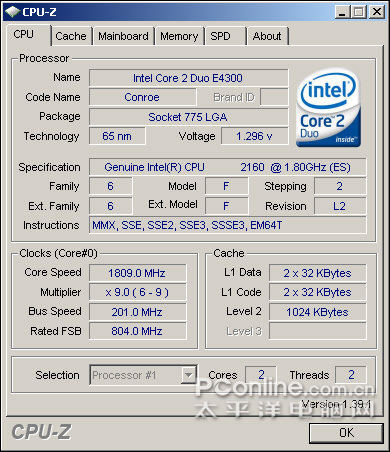 The E2160, which I posted sometime ago that can overclock to 100%, is now loose and ready for public picking and benchmark is now posted on the web. AMDTech's DailyTech posted a news about a Chinese web site comparing the processor to the competition's 65nm flavor of A64 3600+ X2. Expand to read the news posting...
Chinese website PConline benchmarks the Pentium E2160 and E2140
Early benchmarks of Intel’s upcoming Pentium E2100-series reveal the value processor doesn’t fall too far behind the Core 2 Duo E4000-series, when comparing equal clock speeds. Intel is set to introduce its Pentium E2100-series processors in June with sub-$100 pricing. The new processor is based on Intel’s Conroe core but halves the L2 cache of similar Core 2 Duo E4000-series, making for a total of 1MB of L2 cache.
Productivity benchmarks such as Business Winstone 2004 and Multimedia Content Creation Winstone 2004 show an approximate 1-point difference between the Pentium E2160 and Core 2 Duo E4300, favoring the E4300 – both processors have 1.8 GHz clock speeds. Video encoding in TMPGEnc 3.0 reveals a 1 second performance difference between the two processors, and again favoring the E4300.
Productivity Benchmarks
Application Pentium E2160 Core 2 Duo E4300
Business Winstone 2004 28.6 29.3
Multimedia CC Winstone 30.8 31.6
TMPG Enc 3.0 341 340
Gaming Benchmarks
Application Pentium E2160 Core 2 Duo E4300
Half Life 2 129 132
Doom 3 147 151
Far Cry 130 131
Serious Sam 2 121 130
Quake IV 81 82
Gaming performance with a GeForce 8800GTX show small performance differences as well. Games such as Half Life 2, Doom 3 Far Cry and Quake IV show minimal framerate differences around 1-4 FPS, at 1024x768. Serious Sam shows a larger delta at 7 FPS, favoring the Core 2 Duo E4300.
Intel Pentium E
Model Core Frequency L2 Cache FSB Q3'07 Pricing
E2160 1.80 GHz 1MB 800 MHz $84
E2140 1.60 GHz 1MB 800 MHz $74
Expect Intel to unveil the Pentium E2100-series in June with two models, the E2160 and E2140 clocked at 1.8 GHz and 1.6 GHz respectively.
Source:Pentium E2100-series Benchmarks Revealed
There's also another benchmark run over at XTReview.
Saturday, March 24, 2007
Tech Link (Industry): Intel vs. AMD: Today's generation compared
 Want to feed your FanBoyism even more? Then check out the latest article from TheTechReport. I enjoyed reading the Conclusion part, so I never bothered reading the rest of the article. Well, they are a pretty good site, more trustworthy than AMDTech, so check out their great article and indulge yourselves.
Conclusions
The fact that Intel retains the overall performance crown comes as no surprise. As we said at the outset, AMD has no real answer to the Core 2 Extreme X6800 among its dual-core processors. Also, Intel's quad-core CPUs tend to scale better than AMD's Quad FX platform, especially for typical desktop-class applications. Our move to Windows Vista x64 has done little to alter this dynamic. At the same time, Core 2 processors tend to draw less power and to be more energy efficient—sometimes markedly so—than Athlon 64s. Right now, Intel has the magic combination of a superior processor microarchitecture and a more mature, fully realized 65nm manufacturing capability working together on its side.
This one-two punch has allowed Intel to maintain a performance edge at most price points, despite standing pat through AMD's aggressive pricing moves and new model introductions. AMD's current weaknesses manifest themselves most fully in its high-end models, like the Athlon 64 X2 6000+, which draws more power at peak than the Core 2 Extreme QX6700 yet is often outperformed by the less expensive Core 2 Duo E6600. The Athlon 64 looks more competitive in its lower-end incarnations like the X2 5000+ and 4400+, which match up better on both performance and power characteristics against the Core 2 Duo E6300 and E6400. These processors have the benefit of being available in 65nm form, and I'd say the minor performance penalty one pays in performance at 65nm (due to the slower L2 cache) is worth it for the reduced power draw.
This low-to-mid-range territory, incidentally, is where I'd be looking to buy. Many of our tests have shown the benefits of quad-core processors, but honestly, finding applications that will make good use of four cores is not easy—and the list of games that really use four cores is approximately zero. I'd probably grab a Core 2 Duo E6400 and overclock it until it started to glow, if I were putting together a system right now. I must admit, though, that I have an almost irrational fondness for the Core 2 Quad Q6600, probably because it's the most energy efficient processor in our Cinebench power test. The thing is by no means a great deal—two E6600s will set you back over $200 less than a single Q6600—but it's easy to imagine a near-silent multitasking monster built around one.
AMD would do well to expand its 65nm offerings into higher clock frequencies as soon as it can reasonably do so. That may take a while yet, given the limited overclocking headroom we've seen from early 65nm Athlon 64 X2s. Meanwhile, Intel isn't likely to sit still for much longer. Rumors of an April price cut abound, and in light of the Core 2's ample frequency headroom, higher speed grades are a definite possibility, as well. For AMD, its next-generation microarchitecture can't come a moment too soon.
Source:Intel vs. AMD: Today's generation compared
Questions asked, questions answered
Monday, March 19, 2007
Tech Link (Industry): AMD praying ‘Barcelona’ makes up for four-core mistake
 Woah, they finally realized it's the performance that matters and not how the technology is implemented. If products performs, within the consumers' budget, and works like a charm, end users will grab them like hotcakes. I wonder why they never said MCM is better than their 4x4, that is, you need two dual cores to achieve quad core (cripes!!!!). Quotable quotes from the Register:
“If I could do something different, I wish we would have immediately done a MCM - two dual cores and call it a quad-core,” said Mario Rivas, an EVP at AMD, during a recent interview in Austin, “because, I guess, the market sucks it up.”
Expand for more...
By Ashlee Vance in Mountain View (ashlee.vance@theregister.co.uk)
Published Saturday 17th March 2007 00:05 GMT
Exclusive Bruised by a resurgent Intel, AMD wishes it had tackled the four-core era with a different approach. The chipmaker stands behind the technical merits of pumping out a so-called native four-core chip with all four cores on the same piece of silicon.
It, however, admits that Intel gained a major marketing edge by melding a pair of dual-core processors with a multi-chip module (MCM) when it released the "Clovertown" version of Xeon last year. That four-core chip allowed Intel to claim a server processor technology milestone ahead of AMD for the first time in about three years.
“If I could do something different, I wish we would have immediately done a MCM - two dual cores and call it a quad-core,” said Mario Rivas, an EVP at AMD, during a recent interview in Austin, “because, I guess, the market sucks it up.”
Before Clovertown, AMD enjoyed one of the more remarkable runs in server chip marketing and production. It beat Intel to 64-bit extensions for x86 chips and then nailed the release of mainstream, dual-core chips. Besides hitting these milestones, AMD clobbered Intel’s Xeon on overall performance and performance per watt - two of the server world’s favored metrics.
While a high-end part such as Clovertown misses the mainstream, it has proved popular enough with the most demanding customers and analysts to toss the technology and marketing edge back toward Intel. Recent sales figures show that Intel has regained server processor share from AMD, and Intel has shown leading performance on a wide variety of benchmarks.
So, AMD is going retro with its upcoming release of the four-core Barcelona chip, hoping to tap into the momentum of yesteryear.
“Barcelona is as much of event in the x86 world as Opteron was when we launched it,” Rivas said.
Other AMD executives have used this line in recent months, although we’re not sure the pitch fits.
The release of Opteron, as mentioned, gave AMD the first 64-bit x86 chip. More importantly, it turned AMD into a real contender in the server market for the first time.
Barcelona seems like less of a game changer. At the most basic level, it’s simply a better performing chip than today’s dual-core Opterons. AMD expects the processor to provide a 40 per cent surge on most software loads and a much higher boost on floating point-heavy software. Best of all, the chip slides right into existing systems.
AMD hopes to continue the socket compatibility with the four-core follow-on to Barcelona called Shanghai and the eight-core follow-on Montreal - a tidbit you may consider a Register exclusive.
El Reg: Will the upcoming chips Shanghai and Montreal be socket compatible as well?
MR: Yes. That’s the goal. We have not released detailed specs that I know of on those two devices, but that (strategy) has served us well.
Rivas declined to discuss what might happen with Bulldozer - meant to be a native eight-core chip - but hinted that “we have analyst day coming up, and I don’t want to share any more than I have to (before that).”
Channel Stuffing
While Barcelona's release may not match Opteron blow-for-blow, it will stand as a crucial product for AMD’s near-term success.
Sources tell us that the chip is cranking through software at an unreal clip in the labs, beating out AMD’s oft-cited 40 per cent performance gain figure.
Over the last couple of months, AMD executives seemed to change the language around Barcelona’s delivery date, making us wonder if the chip was suffering from a delay. Top staffers started talking up a “late Summer” release rather than a “mid-year” shipments as previously promised.
Rivas said the mid-year plan holds, and we’re looking for Barcelona to ship in July.
The chip can’t come fast enough for AMD’s channel partners who have suffered at the hands of Tier 1 demand.
“We got a little bit distracted,” Rivas said.
AMD has, in fact, blamed its channel shortfall for a recent revenue warning. Rivas said that an unexpected spike in demand for mobile processors along with Tier 1s gobbling up all the available Opterons hurt the supply of gear to the channel.
The channel excuse has rubbed us the wrong way because AMD has spent the last three years celebrating new programs for smaller partners, saying such efforts have been a huge success.
“It was a combination of a boom in our OEM customers and a mix issue that made us not look at our distribution perhaps as well as we could,” Rivas said. “And now we are (suffering) the consequences.”
Moving forward with Barcelona, AMD expects that it will have Opterons for all.
“We will have plenty of silicon” Rivas said. “We will make certain that everyone gets their fair share of the pie.”
Should Barcelona prove as successful as AMD hopes, then the company could be poised to gain server market share against Intel before beginning another game-changing phase.
AMD expects its ATI buy to pay serious data center dividends when the company shifts to 45nm chips in 2008. The chipmaker is looking to combine x86 processors with graphics engines to make products capable of cranking through scientific workloads with unprecedented performance. Such products will be complemented by third-party accelerators that plug right into Opteron sockets - an attack where AMD still enjoys a healthy lead over Intel.
So, come 2008, AMD should gain a shot at seizing the marketing high-ground once again rather than agonizing over missed opportunities. That is if all goes according to plan . . . ®
Source:AMD praying ‘Barcelona’ makes up for four-core mistake
Monday, March 05, 2007
Tech Link (Industry): Is AMD being hypocritical about benchmark ethics?
 George Ou of ZDNet has a recent blog post about AMD*'s comment on Intel* benchmarking. It's always nice to see the other sides of the story from an independent "party/person". I have captured a part of his blog post, check it out.
So we have AMD screaming about Intel’s misleading benchmarks, promises not to do same thing, then appears to turn around gives us outdated scores from a month earlier showing a small AMD advantage when the updated scores actually showed a larger advantage for Intel. I did a little research and it appears that the updated base scores from Dell were published on February 26th 2007 which is only one day before the presentation so it would be reasonable to let that slide. But the updated Intel "Peak" scores from Fujitsu Siemens were published by SPEC.org on February 8 2007 which was nearly three weeks before this AMD presentation at the W Hotel on February 27th 2007 so it's a little hard to believe that AMD wouldn't have known about it yet AMD chose to use a one month old slide showing us outdated inferior Intel results.
Source:Is AMD being hypocritical about benchmark ethics?
Tech Link (Industry): Tech Gloves come off in Intel and AMD chip wars
vnunet has posted an article about the heated war going on between Intel* and AMD*. I will not be posting the full news, but do expand to check out the source. After a relatively quiet period in the competition between AMD and Intel, AMD has once again lashed out against its chip rival.
AMD is accusing Intel of making outdated and skewed comparisons between the chips of the two companies.
Source:Gloves come off in Intel and AMD chip wars
Subscribe to:
Posts (Atom)